

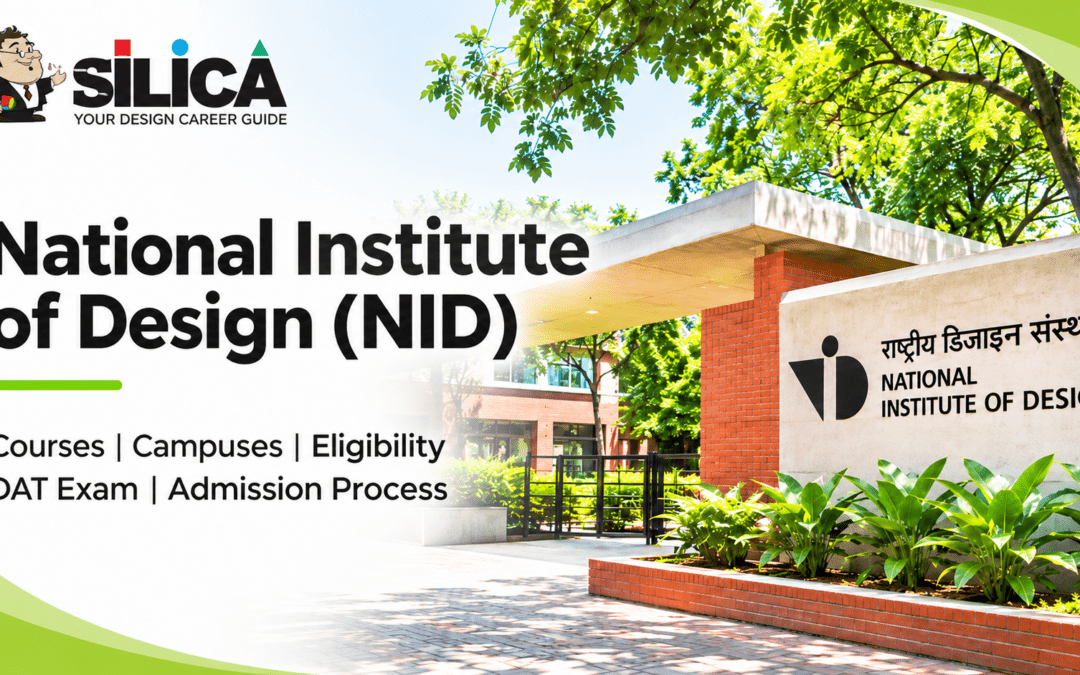
The National Institute of Design (NID) is one of India’s leading design education institutes. It offers programmes in areas such as product design, communication design, textile design, animation and other design specialisations.
Students who want to study design after Class 12 can apply to NID through the Design Aptitude Test (DAT). For the 2027–28 academic year, NID offers Bachelor of Design (B.Des) and 5.5-year Integrated Master of Design pathways at its participating campuses.
If you are planning to apply for NID in 2027, this guide explains the available programmes, campuses, eligibility requirements, entrance exam, important dates and admission process.
What is the National Institute of Design (NID)?
The National Institute of Design is a public design education institution in India. NID Ahmedabad was established in 1961 and is recognised as an Institution of National Importance under the National Institute of Design Act, 2014.
NID education focuses on creative thinking, design research, practical projects, material exploration and solving real-world problems through design.
Students learn how to understand people’s needs, develop ideas, create prototypes and test design solutions.
NID graduates may pursue careers in product design, graphic design, animation, user experience design, textile design and other creative industries
NID Admission 2027: Important Dates
NID has released the official 2027–28 admission schedule. Students planning to apply should check these dates carefully.
| Admission event | Official date |
|---|---|
| NID 2027 registration begins | 10 September 2026 |
| Last date to apply | 30 November 2026 |
| Application correction window | 1–3 December 2026 |
| DAT Prelims admit card | 10 December 2026 |
| NID DAT Prelims 2027 | 20 December 2026 |
| DAT Prelims result | 16 March 2027 |
| DAT Mains | To be announced |
| Final result and counselling | To be announced |
NID Campuses in India
NID has campuses in different parts of India. Students should check the programmes and design disciplines offered at each campus before choosing their preferences.
| NID campus | Location |
|---|---|
| NID Ahmedabad | Gujarat |
| NID Gandhinagar | Gujarat |
| NID Bengaluru | Karnataka |
| NID Andhra Pradesh | Amaravati, Andhra Pradesh |
| NID Haryana | Kurukshetra, Haryana |
| NID Madhya Pradesh | Bhopal, Madhya Pradesh |
| NID Assam | Jorhat, Assam |
The campuses do not all offer the same programmes. Students should review the current admission handbook to confirm course availability, seat intake and campus preferences.
Comparative Analysis of NID Campuses:
To help you better understand the nuances of each campus, here’s a comparative analysis:
| Feature | NID Ahmedabad | NID Gandhinagar | NID Bengaluru | NID Vijayawada | NID Jorhat |
| Establishment | 1961 (Flagship Campus) | 2004 | 2006 (R&D Campus, later expanded) | 2015 | 2019 |
| Focus/Strengths | Broad range of design disciplines, strong industry connections, established alumni network | Specialized design disciplines, intimate learning environment | Interaction Design, UX Design, IT-integrated design | Design for social impact, craft-based design | Sustainable design, traditional crafts of Northeast India |
| Infrastructure | Most extensive infrastructure and resources | Well-equipped labs and workshops | Modern facilities with a focus on digital technologies | Developing infrastructure, focus on local crafts | Developing infrastructure, focus on regional crafts and sustainability |
| Campus Size | Largest campus | Smaller campus | Moderate campus size | Smaller campus | Smaller campus |
| Location Advantages | Located in a major metropolitan city with strong industry presence | Located near Ahmedabad, providing access to industry and cultural resources | Located in India’s tech hub, offering opportunities in IT-related design fields | Proximity to craft clusters and focus on social impact projects | Focus on the unique culture and crafts of Northeast India |
Programs Offered (Common Across Most Campuses, Specific Specializations May Vary):
NID Courses Available in 2027
Students can choose a programme based on their educational qualifications and career interests.
1. Bachelor of Design (B.Des)
B.Des is an undergraduate design programme for students who have completed or are appearing for Class 12.
It introduces students to design principles, drawing, visual communication, materials, creative problem-solving and project development.
2. Integrated Master of Design (M.Des) – 5.5 Years
For the 2027–28 session, NID has introduced a 5.5-year Integrated M.Des pathway, allowing students to pursue an integrated design education route after Class 12.
Important 2027 update: NID Ahmedabad, Gandhinagar and Bengaluru offer the Integrated M.Des pathway rather than a standalone four-year B.Des under the 2027–28 admission structure. Programme options at other NIDs should be checked campus-wise.
3. Master of Design (M.Des)
M.Des is a postgraduate programme for eligible graduates interested in developing advanced design skills and specialisation.
Admissions to postgraduate programmes follow the relevant NID M.Des eligibility requirements and selection process.
NID Eligibility Criteria 2027
Students must meet the educational and age requirements specified by NID.
Educational qualification
Candidates who have passed or are appearing for Class 12 in the relevant academic year may apply for the B.Des/Integrated M.Des route.
Students from Science, Commerce, Arts and Humanities streams are eligible, subject to the official requirements.
Age eligibility
| Category | Eligible date of birth |
|---|---|
| General / General-EWS | On or after 1 July 2006 |
| OBC-NCL / SC / ST | On or after 1 July 2003 |
| PwD reserved category | On or after 1 July 2001 |
| Overseas category | On or after 1 July 2006 |
Candidates awaiting their Class 12 results must also meet the document submission requirements. The official handbook specifies 15 July 2027 as the relevant deadline for submitting the qualifying marksheet in applicable cases.
NID Entrance Exam 2027: DAT Prelims and Mains
Admission to NID is based on the Design Aptitude Test (DAT), which is conducted in two stages.
Stage 1: NID DAT Prelims
The DAT Prelims evaluates students’ ability to understand design problems and respond through creative, analytical and visual thinking.
According to the official 2027 handbook:
-
The test is conducted using paper and pencil or pen.
-
Questions may contain text and visuals.
-
The question paper is in English.
-
The examination duration will be mentioned on the admit card.
The NID DAT Prelims 2027 will be held on 20 December 2026.
Stage 2: NID DAT Mains
Candidates shortlisted after DAT Prelims are eligible for the Mains stage.
For the 2027–28 B.Des/Integrated M.Des admission process, the Mains stage includes Studio Sensitivity and In-person Sensitivity Tests.
These tests assess how students approach design tasks, develop ideas and communicate their thinking.
The official dates for DAT Mains have not yet been announced.
How to Apply for NID Admission 2027
Students can follow these steps to submit their application:
-
Visit the official NID admission website at admissions.nid.edu.
-
Select the appropriate B.Des/Integrated M.Des or M.Des application.
-
Register using the required personal information.
-
Complete the application form and educational details.
-
Upload the required photograph, signature and documents.
-
Pay the applicable application fee.
-
Submit the form and save the confirmation for future reference.
Check all details before submission. Certain information, including the registered mobile number, email address, name and date of birth, cannot be changed during the correction window.
NID Fees 2027: What Students Should Know
Students should check two different types of fees before applying to NID.
Application fee: This is paid when submitting the NID DAT application form. The amount depends on the applicant’s category.
Course fee: This includes the academic tuition fee and other applicable institute charges. The amount varies according to the programme and campus.
For accurate 2027–28 fees, refer to the official admission handbook and campus-specific fee information. Students should also check hostel and living expenses before selecting a campus.
Popular Design Specialisations at NID
NID offers different design disciplines depending on the campus and programme.
Product Design
Students learn to develop useful products by studying user needs, materials, manufacturing processes, ergonomics and product development.
Graphic Design
Graphic Design focuses on visual communication through typography, branding, illustration, layouts and digital media.
Animation Film Design
Students explore storytelling, character development, movement, visual narratives and animation production.
Textile Design
Textile Design includes studying fabrics, colours, patterns, materials, printing and textile applications.
Interaction Design
Interaction Design focuses on how people use digital products, services and interactive systems.
The availability of these disciplines depends on the campus and course. Students should confirm the official 2027 programme list before applying.
How to Prepare for NID DAT 2027
Students preparing for NID should focus on developing their observation, creativity, drawing and problem-solving skills.
1. Practise drawing regularly
Work on perspective drawing, object sketching, human figures, composition and visual storytelling.
2. Improve observation skills
Observe everyday objects, public spaces, packaging and products. Think about how their design could be improved.
3. Solve previous year question papers
Practising NID previous year question papers helps students understand the types of design questions asked and improve their time management.
4. Practise creative problem-solving
Try designing solutions to everyday problems. Explain your ideas through sketches, short descriptions and simple models.
5. Prepare for DAT Mains
Students should practise material handling, model-making and communicating design ideas rather than focusing only on the written examination.
6. Take mock tests
Timed mock tests help students assess their preparation and identify areas that need improvement.
For additional practice, students can explore SILICA’s NID preparation resources.
Career Opportunities After Studying at NID
NID graduates can explore career opportunities across several creative industries.
| Career field | Possible roles |
|---|---|
| Product Design | Product Designer, Industrial Designer |
| Communication Design | Graphic Designer, Brand Designer |
| Digital Design | UX Designer, Interaction Designer |
| Animation | Animator, Storyboard Artist |
| Textile Design | Textile Designer, Surface Designer |
| Design Research | Design Researcher, Design Strategist |
Career opportunities depend on the student’s specialisation, portfolio, practical skills and industry experience.
NID Preparation with SILICA Institute
Students preparing for NID DAT 2027 can explore SILICA Institute’s NID entrance exam preparation programmes.
SILICA provides guidance for design entrance examinations, including practice with drawing, design aptitude, creative thinking and mock tests.
Students can explore available classroom and online preparation options based on their location and study schedule
Frequently Asked Questions About NID 2027
1. What is the National Institute of Design?
The National Institute of Design (NID) is a public design education institution in India offering undergraduate, integrated and postgraduate design programmes.
2. What is the NID entrance exam date for 2027?
The NID DAT Prelims for 2027–28 admissions is scheduled for 20 December 2026.
3. What is the last date to apply for NID 2027?
The last date to submit the NID DAT 2027 application form is 30 November 2026, until 11:59 PM IST.
4. Can Commerce students apply for NID?
Yes. Students from Commerce, Science, Arts and Humanities streams can apply for the undergraduate admission route if they meet the official eligibility requirements.
5. How many NID campuses are there in India?
There are seven campuses across five NID institutions: Ahmedabad, Gandhinagar, Bengaluru, Andhra Pradesh, Haryana, Madhya Pradesh and Assam.
6. Does NID offer B.Des in 2027?
Yes. NID offers B.Des and Integrated M.Des admission routes for 2027–28. The programmes available vary by campus.
7. Is the NID DAT exam difficult?
NID DAT is competitive and requires creative thinking, observation, drawing, problem-solving and design aptitude. Regular practice with previous papers and mock tests can help students prepare.
8. Where can I download NID previous year question papers?
Students can explore NID previous year question papers and practice resources through SILICA’s NID preparation pages and official NID resources.
9. What is the difference between NID DAT Prelims and Mains?
DAT Prelims is the first-stage written examination. DAT Mains is the second stage for shortlisted candidates and includes practical and in-person assessment components for the undergraduate route.
10. Is NID a government institute?
Yes. NID Ahmedabad is a statutory institution recognised as an Institution of National Importance. Other NIDs are also established under the applicable NID legislation.