

How Do You Prepare for the UCEED Entrance Exam?
UCEED is the acronym for Undergraduate Common Entrance Examination for Design. It is an entrance exam that happens every year under the supervision of the Indian Institute of Technology (IIT) Bombay. The latter uses the merit list of the aspirants for admissions to BDes courses.
Follow the steps below to crack UCEED exam 2026 with better preparedness.
Step 1: Have the UCEED Exam Paper Pattern and marking scheme in your mind
Knowing the question paper well is the first step towards preparing for a competitive exam such as UCEED.
UCEED exam paper of UCEED examination in 2027 will have two parts: Part A and Part B.
Understand the UCEED 2027 Exam Pattern
UCEED Part A Exam Pattern 2027
Part A is a computer-based examination lasting two hours. It tests visualisation, observation, analytical thinking and related abilities.
The marking scheme for this part will be as follows:
| Parts | Type of question | Marking scheme | Number of questions | Marks |
| Section 1 | Numerical Answer Type (NAT) questions | 4 marks for each correct answer; no negative marking | 14 | 56 |
| Section 2 | Multiple Select Questions (MSQs) | 4 marks for each correct answer; -1 marks for every wrong answer | 15 | 60 |
| Section 3 | Multiple Choice Questions (MCQs) | 3 marks for each correct answer; -0.71 for each wrong answer | 28 | 84 |
| 57 | 200 |
It will consist of the following parts:
Marking scheme:
- NAT: +4 for correct answers, with no negative marking.
- MSQ: Up to +4 for correct answers, with partial marking and a penalty of -1 for incorrect responses under the prescribed scheme.
- MCQ: +3 for correct answers and -0.71 for incorrect answers.
Example:
Fill in the blanks to keep the sentence grammatically correct as well as meaningful. (MCQ)
……….. the facts, she proceeded with her decision, finally ending up with a …………. situation.
- Nevertheless, happy
- Apparently, initially
- However, noteworthy
- Notwithstanding, sad
- Design Thinking and Problem Solving: In this section, questions on various topics like metaphors, symbols, signs, visual analogies are asked.
Example:
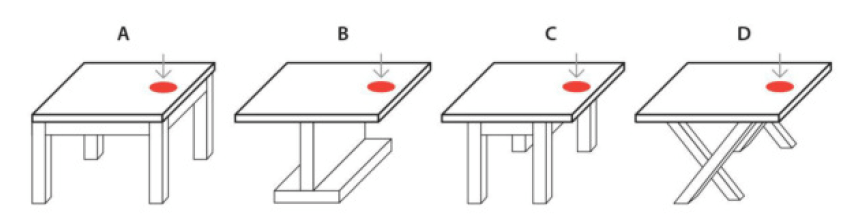
Four square table-tops of the same dimensions are shown below. Only the designs of their supports are different from each other. If a person stands upright on the red mark on each of the tables, which of the tables will topple? (MSQ)
- Environmental and Social Awareness: In this section, candidates are asked questions based on environment and social awareness. You can expect questions related to pollution, population, climate, literature, natural resources, history of art etc. are asked.
Example:
Images of traditional products of certain states of India are shown below. Identify the correct set of states to which these belong. Names of the states are in a random sequence. The products are made out of clay, willow/wicker, wood and brass. (MCQ)
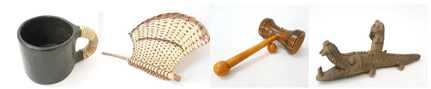
- Maharashtra, Nagaland, Jammu & Kashmir, Chhattisgarh
- Nagaland, Jammu & Kashmir, Chhattisgarh, Andhra Pradesh
- Jammu & Kashmir, Kerala, Andhra Pradesh, Haryana
- Maharashtra, Kerala, Andhra Pradesh, Haryana
- Analytical and Logical Reasoning: In this section, analytical and logical reasoning questions are asked. You can expect questions on patterns, brainteasers, data interpretation, assumptions and conclusions, arguments, etc.
Example:
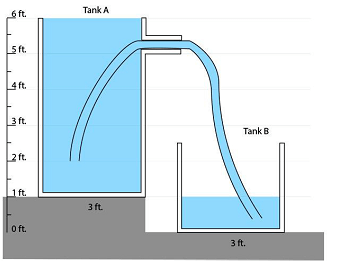
Two water tanks A and B of equal square base of sides 3 feet are shown below. Water flows from tank A to tank B through a tube. What will be the volume (in cubic feet) of water in Tank A when the water stops flowing? (NAT)
- Visualisation and Spatial Ability: In this topic, pictorial and diagrammatic questions are asked to test the transformation/ manipulation of 2D shapes and 3D objects followed by their spatial relationships.
Example:
Two perspective views of the same solid object are shown below. How many surfaces does the object contain? Assume hidden surfaces to be flat. (NAT)
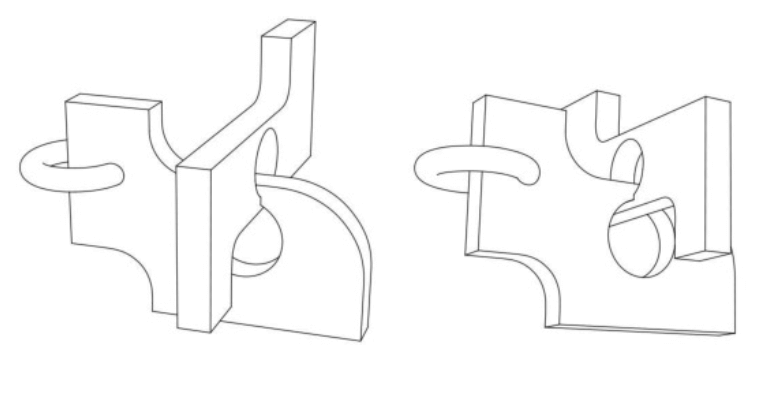
- Observation and Design Sensitivity: This section questions will be asked to test the candidate’s ability to analyze, reason, classify, infer and predict and also ability to discern subtle differences in visual properties and aesthetic outcomes.
Example:
Identify the option that will replace the question mark. (MCQ)
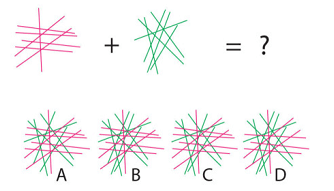
UCEED Part B Exam Pattern 2027
Part B will have one question of drawing carrying 60 marks. You will get a maximum of 30 minutes to answer the question of this part.
Part B is a one-hour, subjective examination designed to evaluate drawing and design aptitude.
| Question Type | Questions | Marks |
|---|---|---|
| Sketching | 1 | 50 |
| Design Aptitude | 1 | 50 |
| Total | 2 | 100 |
The question on the drawing will test your sketching ability plus your understanding of shading, perspective, proportion, composition, and good line quality.
Step 2: Formulate a strategy to answer the questions within the duration of time allotted for the exam
You will get a total of 3 hours to write down the answers. Unless you take the examination with a well-planned strategy, you may not succeed in answering all the questions. So, work on the pace at which you answer the questions.
Step 3: Practice and solve the sample papers of the previous years
Apart from knowing the ins and outs of the question paper for the UCEED examination paper, you also need to strategize how you would answer the questions. One of the best things you can do in this regard is to solve the sample papers of the previous years.
It will help you in the following ways:
- You will be able to find out how long you take to answer questions from specific topics.
- It will help you distribute your time to answer each question so you can answer all the questions.
- This method will make you confident. As a result, you will be able to overcome stage fright.
Step 4: Assess your preparation with mock tests
Solving mock papers constitutes one of the best ways to evaluate your UCEED preparation before the actual day of the examination. The more you practice them, the better. So, try to dedicate as much time as you can in solving UCEED mock test.
Step 5: Read the questions carefully to understand the requirements before you attempt to answer them
You will only be able to answer a question only if you know its requirements. That is to say; you need to understand a question to frame your answer effectively. If you do not understand the question once, read it again.
Step 6: Improve your communication skills by reading newspapers and magazines
You will need to have good comprehension skills in English. Try making reading a habit, especially newspapers and magazines. Once you get into it, you will find a way to improve your communication skills.
Step 7: Improve your general knowledge
One of the important things you need to do well in the UCEED examination is to improve your general knowledge. Again, there is no short cut to learn this skill. You need to keep track of the latest information from current affairs and other aspects.
Step 8: Refer to useful books
The selection of books will play a decisive role in our chances of cracking the UCEED examination. After all, you will study its content to gain an understanding of the important concepts. For best results, you need to choose the right set of books.
Although it is not an easy task to pick on a few books out of the overwhelming number of choices, you can do it with careful consideration. Here are some useful books to which you can refer.
| Name of the Book | Name of the Author |
| UCEED Design Environment & Social Awareness in Design Perspective Combined with Mental & Verbal Aptitude | Sreejanshilpa |
| Cracking CEED & UCEED | Ashok Goel and Arjun Kemal |
Along with these books, you can also study SILICA’s UCEED study material.
UCEED exam dates
If you are an aspirant for UCEED Examination 2027 and have enrolled for it, here are some important dates that you need to remember.
| Event | Dates |
| Application Online | October 1 2027. 1.00 pm |
| Last date for online registration with regular fee | October 31, 2027 |
| Last date for Online Registration with late fee | November 08, 2027; 5:00 pm |
| Admit Card downloading | January 03, 2027, 1:00 pm |
| Date of examination | January 19, 2027 (Sunday) 09:00 am to 12:00 noon |
| Declaration of results | March 07, 2027 |
How to Prepare for UCEED 2027: Step-by-Step Guide
1. Understand the UCEED 2027 Syllabus
The first step is to become familiar with the official UCEED syllabus. This helps you identify important subjects and plan your preparation.
UCEED Part A syllabus includes:
- Visualisation and spatial reasoning
- Practical and scientific knowledge
- Observation and design sensitivity
- Environment and society
- Analytical and logical reasoning
- Language comprehension
- Creativity
UCEED Part B syllabus includes:
- Drawing, perspective and proportion
- Composition and shading
- Creative problem-solving
- Design aptitude and empathy-based solutions
Instead of studying every topic equally, identify the areas where you need additional practice.
2. Improve Visualisation and Spatial Reasoning
Visualisation and spatial reasoning are important areas of UCEED Part A.
Students should practise identifying patterns, understanding three-dimensional objects and imagining how shapes change when rotated, folded or viewed from different angles.
Practice activities:
- Solve paper-folding and cube-based questions.
- Practise mental rotation of 2D and 3D objects.
- Identify patterns and relationships between shapes.
- Observe everyday objects from different viewpoints.
Regular practice can improve your ability to understand visual information and solve unfamiliar questions.
3. Develop Observation and Design Sensitivity
UCEED evaluates how carefully students observe objects, situations and their surroundings.
Develop the habit of examining everyday products such as chairs, bottles, bags, doors and public facilities.
Ask yourself:
- Who uses this product?
- What problem does it solve?
- Is it comfortable and easy to use?
- How could its design be improved?
For example, observe a water bottle used by schoolchildren. Think about its grip, weight, opening mechanism and ease of cleaning.
This activity helps develop practical design thinking rather than simply memorising concepts.
4. Practise Logical and Analytical Reasoning
Logical reasoning questions assess your ability to analyse information and identify relationships.
Focus on:
- Number and visual patterns
- Logical sequences
- Problem-solving questions
- Data interpretation
- Spatial relationships
Begin with questions that help you understand the concept, then gradually introduce timed practice.
Avoid spending too much time on a single difficult question during mock tests.
5. Strengthen Drawing Skills for UCEED Part B
Drawing preparation is an important part of UCEED entrance exam 2027 because Part B carries 100 marks.
Students should practise drawing objects, people and everyday scenes with correct proportions, perspective and composition.
Useful drawing exercises:
- Draw a room using one-point and two-point perspective.
- Sketch people performing everyday activities.
- Practise product sketches from different angles.
- Create scenes showing depth and movement.
- Work on line quality, shading and composition.
Spend at least 30–45 minutes on drawing practice each day as part of your preparation routine.
Focus on communicating ideas clearly instead of making every sketch highly decorative.
6. Improve Creative Thinking and Design Aptitude
Design aptitude involves understanding problems and developing useful solutions.
For example, imagine a crowded school corridor where students struggle to locate classrooms.
How could you improve the experience through signs, colours, maps or other design solutions?
Try to develop more than one idea before choosing the most suitable option.
When practising design aptitude questions, consider usability, accessibility, practicality and the needs of different users.
7. Solve UCEED Previous Year Question Papers
Solving previous year papers is one of the most useful ways to understand UCEED question formats and assess your preparation.
Students can practise the UCEED Paper 2026, 2025, 2024 and earlier question papers to become familiar with the examination.
How to use previous year papers effectively:
- Start by solving questions topic-wise.
- Attempt complete papers under timed conditions.
- Check Part A responses using official answer keys.
- Review incorrect and unanswered questions.
- Practise Part B questions separately and seek feedback on drawing and design solutions.
Students can explore UCEED Previous Year Question Papers for additional practice.
8. Take Regular UCEED Mock Tests
Mock tests help students assess their preparation before the actual examination.
A full-length UCEED mock test should follow the official three-hour format, including two hours for Part A and one hour for Part B.
After every test, review:
- Accuracy in NAT, MSQ and MCQ questions
- Time spent on difficult questions
- Topics requiring additional revision
- Drawing composition and clarity
- Ability to complete both parts within the time limit
Use the results to adjust your study plan rather than focusing only on your total score.
Practise with UCEED Sample Papers and timed tests to build familiarity with the examination.
UCEED 2027 Preparation: 60-Day Study Plan
With the UCEED 2027 examination scheduled for January 17, students preparing in November and December 2026 can follow a focused revision plan.
| Preparation Period | Main Focus | Recommended Activities |
|---|---|---|
| Days 1–15 | Understand concepts | Review the syllabus, practise visual reasoning, drawing fundamentals and observation |
| Days 16–30 | Topic-wise practice | Solve reasoning questions, practise Part B drawing and work through previous year papers |
| Days 31–45 | Mock tests and improvement | Attempt timed mock tests, analyse mistakes and revise weaker topics |
| Days 46–55 | Final revision | Review important concepts, practise sketching and repeat difficult question types |
| Days 56–60 | Exam readiness | Light revision, review exam instructions and maintain a consistent routine |
This plan is a suggested preparation schedule. Students can adjust the time allocated to each topic based on their current skills.
Daily Study Timetable for UCEED 2027
A consistent routine is often more useful than studying for long hours without a clear plan.
Here is a suggested three-hour daily timetable.
| Activity | Daily Time |
|---|---|
| Visualisation and spatial reasoning | 40 minutes |
| Logical reasoning and observation | 35 minutes |
| Drawing and sketching | 45 minutes |
| Design aptitude practice | 30 minutes |
| Previous year questions and review | 30 minutes |
| Total | 3 hours |
On selected days, replace the regular timetable with a full-length mock test and review the results afterwards.
Common Mistakes to Avoid During UCEED Preparation
Students sometimes focus heavily on one subject while overlooking other important areas of the examination.
Avoid these common mistakes:
- Ignoring Part B: Practise sketching and design aptitude throughout your preparation.
- Memorising answers: Focus on understanding the reasoning behind solutions.
- Skipping mock-test analysis: Review mistakes after every test.
- Using outdated exam information: Follow the official UCEED 2027 syllabus and marking scheme.
- Practising without time limits: Introduce timed tests to improve examination readiness.
- Neglecting observation: Pay attention to everyday products, spaces and user experiences.
A balanced preparation approach helps students develop the different skills assessed in UCEED.
How SILICA Institute Can Help with UCEED 2027 Preparation
Students looking for structured preparation can explore UCEED Entrance Exam Coaching at SILICA Institute.
UCEED preparation requires regular practice in visual reasoning, logical thinking, observation, sketching and design aptitude.
Students can also explore UCEED Online Coaching and study resources based on their learning preferences.
Practising with feedback can help students identify areas that need improvement and prepare more effectively for the examination.
Planning to appear for UCEED 2027? Explore SILICA Institute’s UCEED preparation programmes and request guidance on your study plan.
Frequently Asked Questions About UCEED 2027 Preparation
1. How should I start preparing for UCEED 2027?
Start by understanding the official UCEED 2027 syllabus and exam pattern. Practise visual reasoning, observation, logical reasoning, drawing and design aptitude. Solve previous year papers to understand the types of questions asked.
2. Can I prepare for UCEED 2027 in two months?
Two months of focused preparation can help students revise important topics, practise previous year papers and improve their examination readiness. However, the results depend on existing skills, consistency and the quality of practice.
3. Is drawing compulsory for UCEED 2027?
Yes. UCEED 2027 Part B includes a compulsory sketching question worth 50 marks and a design aptitude question worth 50 marks. Students should prepare for both.
4. How many questions are there in UCEED 2027?
UCEED 2027 Part A contains 57 questions worth 200 marks. Part B contains two subjective questions worth 100 marks. The complete examination carries 300 marks.
5. Is there negative marking in UCEED 2027?
Yes. Part A MCQs carry a penalty of -0.71 marks for incorrect answers. MSQs have a penalty of -1 under the specified marking rules, while NAT questions have no negative marking.
6. Which previous year papers should I solve for UCEED 2027?
Students should prioritise recent papers, including UCEED 2026, 2025 and 2024, before moving to earlier years. Review the solutions and identify topics requiring additional practice.
7. What is the best daily study routine for UCEED preparation?
A daily routine that combines reasoning, visualisation, drawing, design aptitude and previous year questions is useful. Allocate additional time to weaker areas and attempt full-length mock tests regularly.
8. When is the UCEED 2027 exam?
The UCEED 2027 examination is scheduled for Sunday, January 17, 2027, from 9:00 AM to 12:00 noon.

0 Comments