

4 Lesser-Known Tricks for Cracking UCEED
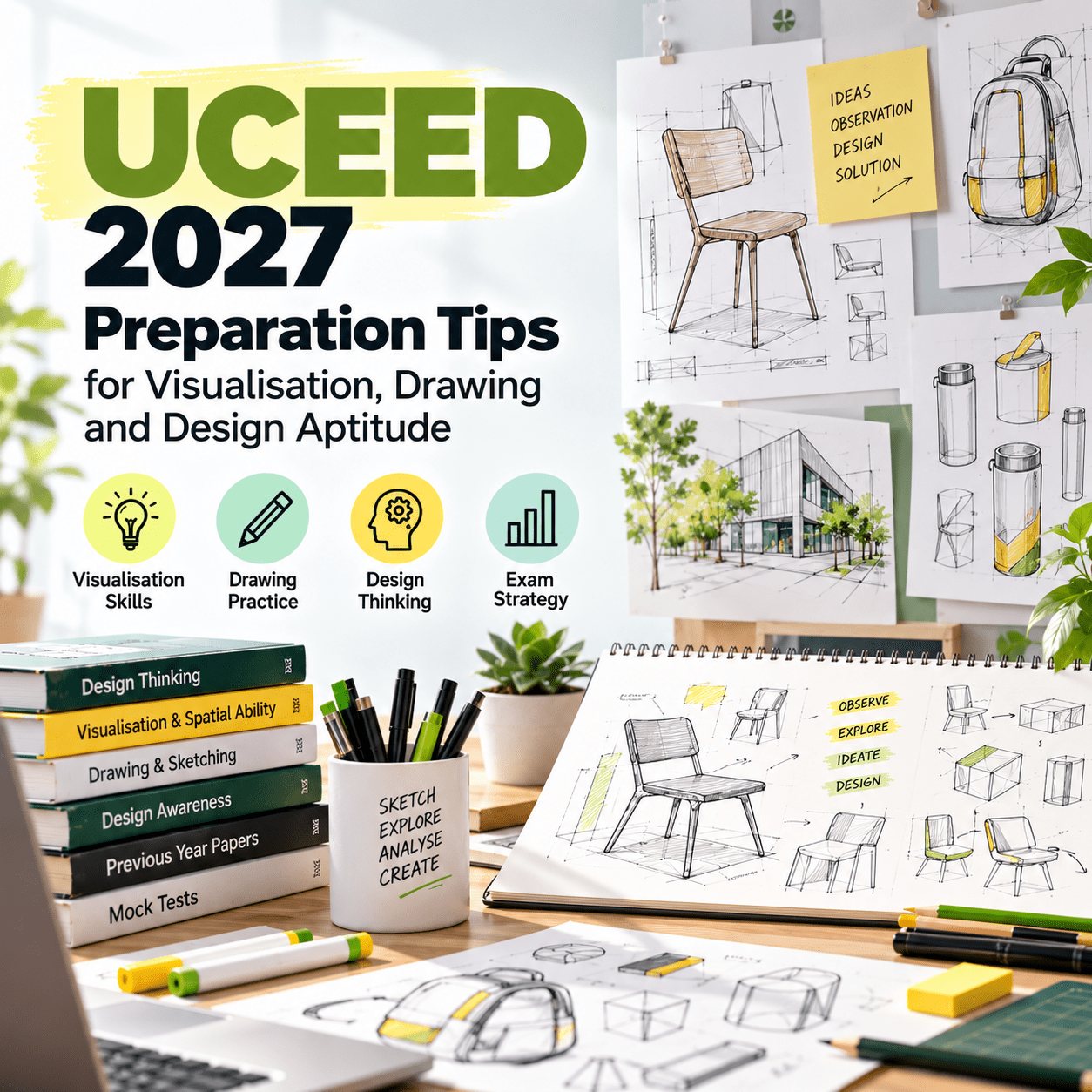
4 Lesser-Known Tips to Prepare for UCEED 2027
Preparing for UCEED 2027? You may already be practising drawing, solving aptitude questions and reading about design. But are you using your practice time effectively?
UCEED preparation is not just about how much you study. It is also about how you observe things, approach unfamiliar problems and learn from your mistakes. Sometimes, small changes in your daily routine can make your preparation more effective.
For example, instead of sketching random objects, you can practise explaining why they are designed in a particular way. Instead of solving mock tests one after another, you can analyse the questions that slow you down.
In this blog, we share seven practical UCEED 2027 preparation tips that can help you improve your observation, visualisation, design thinking and exam strategy.
What Is UCEED 2027?
The Undergraduate Common Entrance Examination for Design (UCEED) is conducted by IIT Bombay for admission to Bachelor of Design (B.Des.) programmes at participating institutes.
UCEED evaluates a range of abilities, including visualisation, spatial reasoning, observation, analytical thinking, creativity and design aptitude.
The UCEED 2027 examination is scheduled for January 17, 2027, from 9:00 AM to 12:00 noon. The paper consists of Part A and Part B, and candidates must prepare for both sections.
For the latest syllabus, examination pattern and instructions, visit the official UCEED 2027 website.
7 Lesser-Known UCEED 2027 Preparation Tips
1. Train Your Brain to Visualise Objects in 3D
One useful way to improve your visualisation skills is to practise thinking about objects from different viewpoints.
When you look at a chair, bottle, shoe or storage box, do not stop at its front view. Try to imagine how it would look from above, below or behind. Think about its proportions, dimensions and the relationship between its different parts.
You can also practise drawing simple objects from multiple angles or visualising how a flat shape might look when folded into a three-dimensional form.
Try this exercise: Choose an everyday object and sketch it from three different viewpoints. Then compare your sketches with the actual object.
This exercise encourages you to think about shapes and spatial relationships rather than relying only on what you see in front of you.
2. Turn Everyday Problems into Design Exercises
You do not need to wait for a practice paper to develop your design thinking. Everyday situations can provide plenty of opportunities to practise.
Think about a crowded bus stop, a difficult-to-open package, an uncomfortable chair or a confusing signboard. Ask yourself what makes the situation inconvenient and how it could be improved.
Follow these three steps:
-
Observe: Identify the problem and the people affected by it.
-
Think: Come up with two or three possible solutions.
-
Sketch: Draw the solution you think would work best and explain why.
For example, if a school bag is uncomfortable to carry, consider its weight distribution, straps, storage compartments and the needs of the student using it.
This habit helps you move beyond simply drawing an object and start thinking about its purpose, usability and users.
3. Maintain a Small Design Observation Journal
Many students practise aptitude questions but do not spend enough time observing the designed world around them.
A design journal is a simple way to build this habit. You can use a notebook or a digital document to record interesting products, packaging, signs, furniture, buildings and interfaces that you encounter.
For each observation, note three things:
-
What caught your attention?
-
What makes the design useful or effective?
-
What would you change to improve it?
You do not need to write long explanations. A small sketch and a few notes are enough.
Over time, your journal can become a useful revision resource for design principles, observations and creative ideas.
4. Practise Explaining Your Ideas, Not Just Drawing Them
A drawing may look attractive, but it should also communicate the intended idea clearly.
When practising a design problem, first understand what the question is asking. Think about the user, the purpose of the design and the problem that needs to be solved.
Then create a sketch that communicates your solution. Pay attention to proportion, perspective, composition and the clarity of the main idea.
After completing the sketch, ask yourself:
-
Can someone understand my idea without a lengthy explanation?
-
Have I addressed the actual problem?
-
Are the important details visible?
-
Have I spent too much time on unnecessary decoration?
This self-review can help you improve the way you communicate design ideas under time pressure.
5. Analyse Your Mock Tests Instead of Only Checking Your Score
UCEED Mock tests are useful, but the real learning often happens after you finish them.Instead of looking only at your score, review how you approached the questions. Identify which topics caused difficulty, which questions took too long and where you made avoidable mistakes.
Maintain a simple mistake tracker with three columns:
| Question or topic | What went wrong? | What to practise next |
|---|---|---|
| Spatial reasoning | Could not visualise the rotation | Practise object rotations |
| Logical reasoning | Missed a condition | Solve similar reasoning questions |
| Drawing exercise | Proportions were unclear | Practise basic forms and perspective |
Review this tracker every week and use it to plan your next practice session.
This approach makes mock tests more useful because each test gives you a clear idea of what to improve.
6. Learn to Manage Time According to the Question
Spending too much time on one difficult question can affect your ability to complete the rest of the paper.
During practice, observe how long different question types take you. If you repeatedly get stuck on a particular type, practise similar questions separately before attempting another full paper.
For timed tests, develop a simple approach:
-
Read the question carefully before answering.
-
Identify what the question requires.
-
Avoid getting stuck on a single problem for too long.
-
Follow the instructions and time limits for each part.
-
Review your time allocation after the test.
Do not assume that rushing through every question will improve your performance. The aim is to balance speed with careful thinking and accuracy.
Also, understand the official UCEED 2027 marking scheme before deciding how to approach different question types.
7. Use Previous Years’ Question Papers to Find Your Weak Areas
Previous years’ UCEED question papers can help you become familiar with the examination format and the variety of questions you may encounter.
However, simply solving papers is not enough. Use them to identify patterns in your mistakes and decide where you need more practice.
Try this method:
First attempt: Solve a paper under timed conditions.
Review: Check the official answer key and identify the questions you found difficult.
Practise: Work on the topics where you made mistakes.
Reattempt: Solve similar questions to check whether your understanding has improved.
Avoid memorising answers. Focus on understanding the concepts and applying them to different problems.
How to Prepare for UCEED Part A
Part A assesses several skills, including visualisation and spatial ability, observation and design sensitivity, environmental and social awareness, analytical reasoning, language and creativity, and practical knowledge.
To prepare effectively, follow a balanced routine.
-
Practise visual and spatial reasoning questions.
-
Work on logical and analytical problems.
-
Improve your observation of objects, patterns and visual details.
-
Review the topics listed in the official syllabus.
-
Solve previous years’ question papers.
-
Analyse your mistakes and revise difficult concepts.
Rather than focusing on only one topic, monitor your progress across the syllabus and give extra attention to areas where you need improvement.
How to Improve Your UCEED Drawing Skills
Drawing practice should be regular and purposeful. You do not need to spend hours creating highly detailed illustrations every day.
Start with everyday objects and practise their shape, proportion and perspective. Gradually move on to scenes involving people, objects and their surroundings.
Try drawing the same object from different viewpoints. You can also practise arranging objects in a scene or illustrating how a person uses a product.
After every exercise, check whether your drawing communicates the intended idea clearly. If the proportions are incorrect or the composition is confusing, repeat the exercise and focus on those areas.
Remember that design aptitude involves more than drawing. Your preparation should also include observation, problem-solving and an understanding of how designs serve their users.
A Simple Weekly Routine for UCEED 2027
If you are unsure how to fit these tips into your preparation, use the following example as a starting point.
| Day | Main activity |
|---|---|
| Monday | Visualisation and spatial reasoning |
| Tuesday | Logical reasoning and aptitude practice |
| Wednesday | Drawing, proportion and perspective |
| Thursday | Design observation and problem-solving |
| Friday | Previous years’ questions |
| Saturday | Timed mock test and performance review |
| Sunday | Revision and practice of weak areas |
Adjust the schedule according to your current level and available time. You can combine activities on days when you have more time or give additional sessions to topics that you find difficult.
The important thing is to practise consistently and review your progress rather than following a timetable without understanding whether it is helping.
Common UCEED Preparation Mistakes to Avoid
While preparing for UCEED 2027, avoid these common mistakes:
-
Practising drawing without working on aptitude and reasoning.
-
Solving questions without reviewing incorrect answers.
-
Ignoring the official syllabus.
-
Taking mock tests without analysing performance.
-
Spending too much time making sketches look decorative.
-
Using too many resources without following a consistent plan.
-
Relying on outdated examination information.
A focused preparation routine can help you make better use of your study time and identify the skills that need more attention.
How Can SILICA Institute Help with UCEED Preparation?
Preparing independently can work well for students who have a clear study plan and can evaluate their own progress. However, some students may benefit from structured guidance, regular practice and feedback on their work.
When choosing a design entrance coaching programme, consider the course structure, practice materials, mock tests, guidance for drawing exercises and the support available for clearing doubts.
SILICA Institute offers design entrance preparation resources for students exploring their options. You can visit the SILICA UCEED sample papers page to explore relevant practice resources.
Frequently Asked Questions About UCEED 2027
1. What are the best preparation tips for UCEED 2027?
Understand the syllabus, practise visualisation and reasoning, observe everyday designs, sketch regularly and solve previous years’ question papers. Analyse mock tests to identify your weak areas.
2. How can I improve visualisation skills for UCEED?
Practise imagining objects from different angles, drawing simple three-dimensional forms and understanding how two-dimensional shapes relate to three-dimensional objects. Regular practice can help you become more comfortable with spatial problems.
3. Is drawing important for UCEED?
Yes. Drawing and design aptitude are assessed in Part B. Practise proportion, perspective, composition and clear visual communication while preparing for the other syllabus areas.
4. Are mock tests useful for UCEED preparation?
Yes. Mock tests help you practise under timed conditions and identify areas that need improvement. Reviewing your answers after each test is just as important as attempting the test itself.
5. Where can I find UCEED previous years’ question papers?
You can download previous question papers and answer keys from the UCEED Exam Paper 2027 downloads page.
6. When is the UCEED 2027 exam?
UCEED 2027 is scheduled for January 17, 2027, from 9:00 AM to 12:00 noon. Check the official website for the latest examination instructions and updates.
Final Thoughts
Preparing for UCEED is not only about studying more. It is about learning how to observe, think, solve problems and communicate ideas effectively.
Start by making small changes to your daily routine. Observe the designs around you, practise visualisation, maintain a design journal and learn from every mock test you attempt.
Most importantly, keep track of your progress and give yourself enough time to work on your weak areas.
With consistent practice and a clear preparation strategy, you can approach UCEED 2027 with greater confidence.
Start your UCEED preparation with SILICA Institute and take the next step towards your design education goals.