

 CEED Sample Papers with Answers PDF- Practice & Preparation
Practising CEED sample papers and previous year question papers helps candidates understand the CEED exam pattern, strengthen their design aptitude, and improve creativity, logical reasoning and problem-solving skills. Conducted by IIT Bombay for postgraduate design admissions, CEED evaluates candidates through both Part A (objective) and Part B (drawing and design) To prepare effectively for the CEED entrance exam, candidates should practise previous year question papers, attempt the CEED mock test, download sample paper PDFs, review answer keys and learn from solved-paper video explanations to build confidence for CEED 2027.
Download for the actual year-wise CEED papers? Download official CEED question papers PDFs (2015-2026) with answer keys.
 Get CEED Sample Papers 2026
CEED Preparation Check 
Take this 5 question test and Check your CEED exam Preparedness
CEED Preparation Test SEO
CEED Online Mock Test
CEED Sample Paper
Please fill the form below.
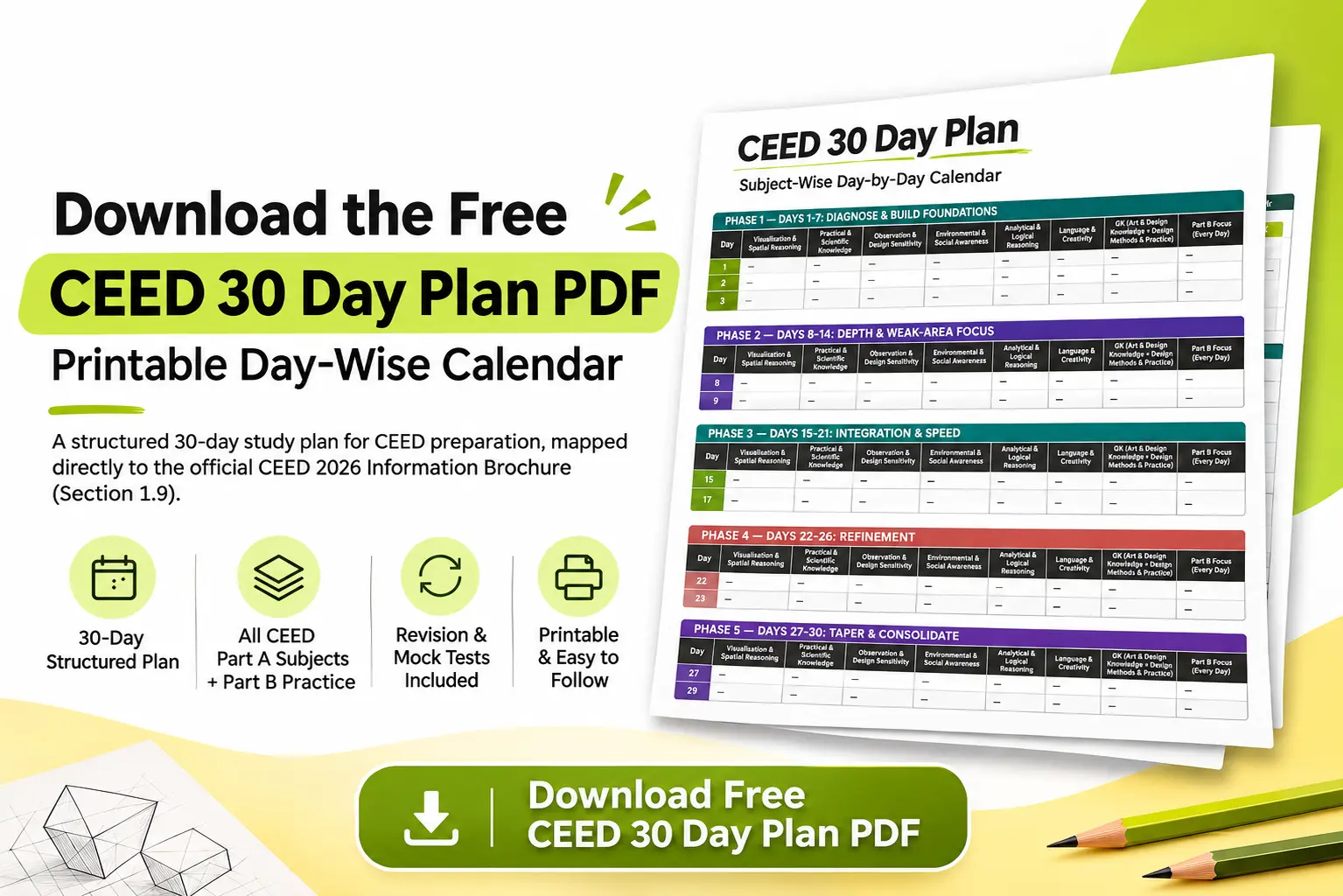
Download CEED 30 days Study Plan
Please fill the form below.
Enquire Now
Please fill the form below.
CEED Preparation 2027 /2028 Question Paper Solved video
CEED Sample Papers PDF 2027 – Solved Practice Questions for Part A & Part B
Practising CEED 2027 sample papers is a useful way to become familiar with different question formats and develop the skills required for the examination.
Sample papers provide opportunities to practise Design aptitude, visual reasoning, analytical thinking and creative problem-solving. Regular practice also helps students identify their strengths and areas that need improvement.
Use CEED practice papers to:
- Understand different types of design entrance questions.
- Improve visualisation and observation skills.
- Develop logical and analytical thinking.
- Practise creative problem-solving.
- Improve examination time management.
- Evaluate your preparation through regular practice.
CEED 2027 Exam Pattern – Understand Part A and Part B
Understanding the CEED examination pattern is essential before starting your preparation. The examination consists of two parts, designed to evaluate different aspects of a candidate’s design aptitude and creative abilities.
Part A – Computer-Based Examination
Part A evaluates candidates through objective and computer-based questions. It focuses on areas such as:
- Visual and Spatial Ability
- Environmental and Social Awareness
- Analytical and Logical Reasoning
- Language and Creativity
- Design Thinking and Problem-Solving
Part B – Drawing and Design Skills
Part B evaluates candidates’ creative and design-related abilities through subjective questions.
Important areas include:
- Drawing and Illustration
- Visualisation and Creativity
- Design Sensitivity
- Problem Identification
- Communication and Presentation Skills
Candidates should practise both parts regularly to develop a balanced preparation strategy.
Note: Refer to the official CEED 2027 information brochure for the confirmed examination pattern, marking scheme and syllabus.
Key Highlights: CEED Sample Papers 2027
| Detail | Information |
|---|---|
| What it is | Practice questions designed for CEED preparation |
| Best for | Understanding Part A and Part B question formats |
| Coverage | Part A (MCQ, MSQ, NAT) and Part B (Drawing and Design) |
| Includes | Practice questions, answers and explanations (where available) |
| Topics | Visual reasoning, design aptitude, creativity and problem-solving |
| Sample Papers vs PYQs | Sample papers offer practice; PYQs contain actual previous exam questions |
| How to use | Practise questions, review answers and identify weak areas |
| Next step | Attempt a CEED Mock Test |
| Previous Year Papers | Explore CEED Previous Year Question Papers |
Note: Include only answer keys and detailed solutions that are actually available on the SILICA page.
CEED Sample Papers 2027
Practising CEED Sample Papers 2027 is an effective way for aspiring designers to understand the examination format and develop essential design aptitude skills. Working through practice questions helps candidates improve visual perception, logical reasoning, creativity and problem-solving abilities. Regular practice also allows students to assess their CEED preparation, identify areas that need improvement and become more confident when attempting the actual examination. At SILICA Institute, students can strengthen their CEED preparation through structured practice, design-focused learning and expert guidance.
Sample Questions with Answers for CEED 2027 Practice
Q.1. Imagine a pentagon-shaped building. The walls of the building are the sides of the pentagon, and there is a watchtower at each vertex. Each watchtower can have guards who can watch two walls connected to the watchtower. What is the minimum number of guards required if each wall needs to be watched by at least 3 guards? (CEED 2023 – Part A, Question 1)
Answer: 8 Guards
Explanation:
A pentagon has five walls and five vertices. Each watchtower is positioned at a vertex and can monitor the two walls connected to it.
For every wall to be monitored by at least three guards, the total number of guards across its two adjoining watchtowers must be at least three.
A suitable arrangement is:
-
Tower 1: 2 guards
-
Tower 2: 1 guard
-
Tower 3: 2 guards
-
Tower 4: 1 guard
-
Tower 5: 2 guards
Total = 2 + 1 + 2 + 1 + 2 = 8 guards.
This arrangement ensures that every wall is monitored by at least three guards.
Q.2. In a camera, the opening through which light enters is called the aperture. The distance between the closest and farthest parts of a view captured in a photograph that remain in focus is called the depth of field. (CEED 2019, Part A, Question 31)
Assuming all other camera settings remain the same, which of the following statements is TRUE?
A. The larger the aperture, the larger the depth of field.
B. The smaller the aperture, the larger the depth of field.
C. The depth of field is not affected by the aperture size.
D. The larger the aperture, the larger the image captured.
Answer: B.
Explanation:
A smaller aperture (higher f-number) generally produces a greater depth of field, keeping more of the scene in focus. A larger aperture (lower f-number) produces a shallower depth of field, making the background more blurred.
FAQ for CEED Sample Papers
1. What is CEED Exam?
CEED (Common Entrance Examination for Design) is conducted by IIT Bombay for admission to MDes programs at IISc Bangalore, IITs and selected design institutes.
2. Where can I download CEED sample papers and previous year papers?
for CEED 2027 prep for here’s download sample papers. All papers include Part A and Part B solutions.
3. What is the difference between CEED Part A and Part B?
Part A tests design aptitude through objective questions, including MCQs, MSQs, and numerical answer questions. Part B evaluates design, drawing, and writing skills through subjective questions.
4. What is the structure of the CEED exam?
The examination is split into two distinct parts conducted on the same day:
Part A (1 Hour) A computer-based test containing Numerical Answer Type (NAT), Multiple Select Questions (MSQ), and Multiple Choice Questions (MCQ).
Part B (2 Hours) A pen-and-paper test focused on sketching, drawing skills, visual communication, and creative design aptitude.
5. What is the benefit of solving CEED sample papers?
CEED consists of two parts — Part A and Part B. Part A is a computer-based test with objective questions such as NAT (Numerical Answer Type), MSQ (Multiple Select Questions), and MCQ (Multiple Choice Questions). Part B is a pen-and-paper test that evaluates design aptitude, creativity, visual communication, and problem-solving skills through subjective drawing and design-based questions.
6. Is there negative marking in the CEED exam?
7. How do CEED sample papers help in exam preparation?
8. Are CEED question papers available with final answer keys?
Yes. CEED releases official question papers + final answer keys every year. You can download all solved CEED question papers in PDF format from SILICA’s CEED Papers section.
9. What is the eligibility criteria for CEED?
To be eligible for appearing in CEED 2027, candidates must fulfill at least one of the following qualifications:
- Must have completed a graduate, diploma, or postgraduate degree program of at least three years duration after the 10+2 level, OR
- Must be appearing for the final examination of such a qualifying program by July 2027, OR
- Must have completed the GD Arts diploma program (10+5 level) by July 2027.
Google Reviews

Krishika Sawant
Choosing SILICA is the best decision I made My experience with all faculties and staff is absolutely great !! Supportive and Encouraging teachers and Helpful and staff. Special thanks to Pooja Ma'am our coordinator she helped me a lot through this journey.
SILICA - Borivali, Mumbai
Vasudha Gaikwad
SILICA - M.G.Road, Pune
Maahi Shetty
I love how organized and well planned each of our sessions are! Besides the predation for entrances we are exposed to various designs, get first hand tips from past alumni who are currently in top tier design schools. The quality of teaching and approachable teachers definitely make the experience a lot more enriching.
SILICA - BTM, Bangalore
Kohina Agnihotri
SILICA - Indore
