

How to Prepare for UCEED 2027 in 2 Months: A Step-by-Step Study Plan
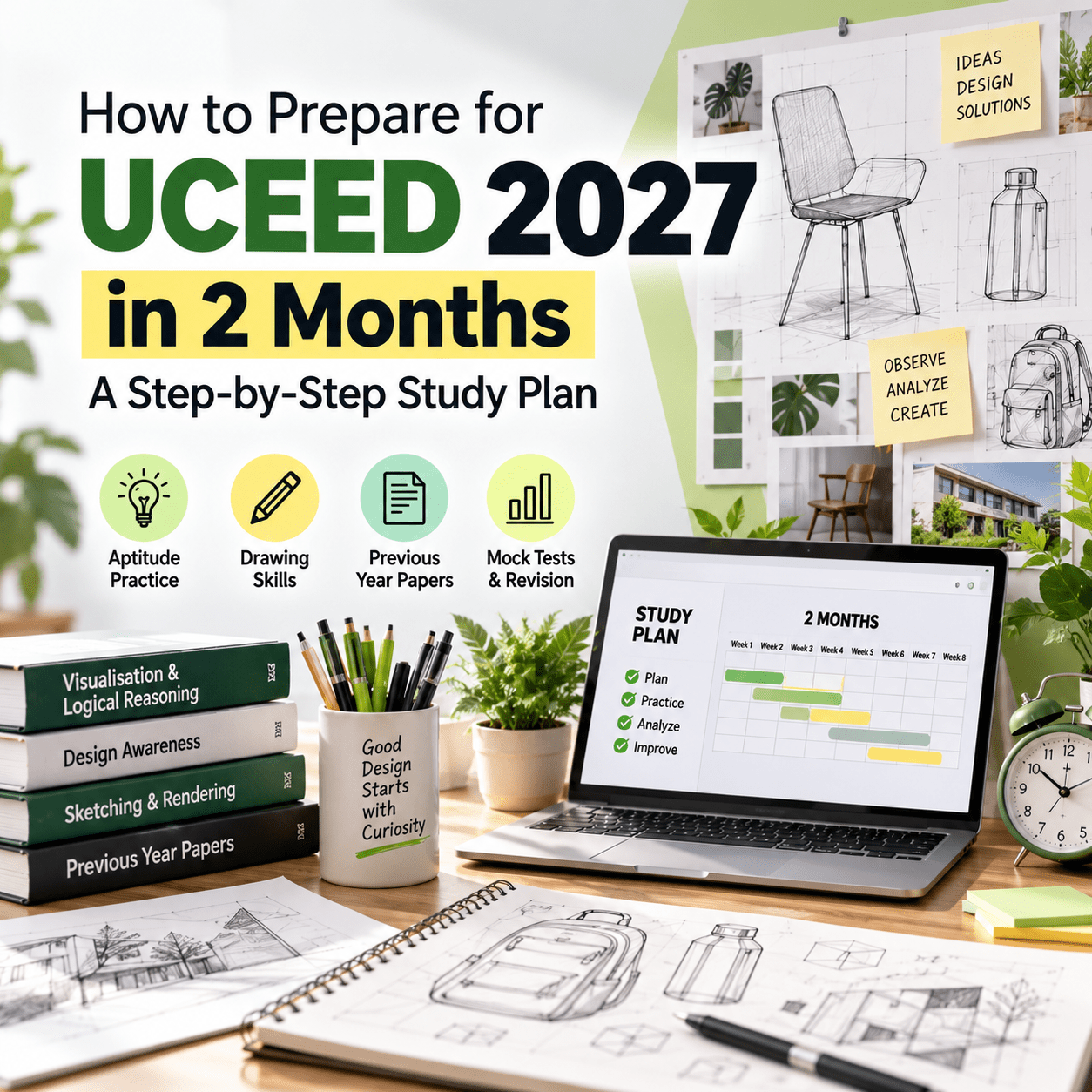
Have you started preparing for UCEED 2027 but feel that there is not enough time left? You are not alone. Many students find it difficult to balance aptitude practice, drawing, design thinking and revision while preparing for a design entrance exam.
The good news is that two months can be used productively if you have a realistic study plan and know where to focus your efforts. Instead of trying to study everything at once, divide your preparation into smaller tasks, practise regularly and track your progress.
UCEED is not just about drawing beautiful pictures. It tests how you observe things, understand problems, analyse information and think creatively. Your preparation should develop these skills alongside your examination technique.
In this guide, we will explain how to prepare for UCEED 2027 in two months, with a practical 60-day timetable, subject-wise preparation tips and advice on making the most of your remaining time.
UCEED 2027: Important Exam Details
Before starting your preparation, understand the examination structure and check the official syllabus.
The Undergraduate Common Entrance Examination for Design (UCEED) is conducted by IIT Bombay for admission to the Bachelor of Design (B.Des.) programmes at participating institutes.
Here are the key details for UCEED 2027:
-
Exam date: January 17, 2027
-
Conducting institute: IIT Bombay
-
Examination duration: 3 hours
-
Examination structure: Part A and Part B
-
Official website: https://www.uceed.iitb.ac.in/2027/
Part A evaluates skills such as visualisation, observation, design sensitivity, logical reasoning and other areas specified in the syllabus. Part B focuses on drawing and design aptitude.
Always refer to the official UCEED 2027 website and information brochure for the latest examination pattern, marking scheme and syllabus.
Is Two Months Enough to Prepare for UCEED 2027?
Two months can be enough to make meaningful progress, particularly if you already have some familiarity with aptitude questions and drawing. However, the results will depend on your current skill level, available study time and consistency.
If you are starting from scratch, you may need to prioritise the fundamentals and practise the most challenging areas regularly. If you have already covered the basics, use the remaining time for timed practice, UCEED previous years question papers and mock-test analysis.
The important thing is to avoid studying without a plan. Decide what you need to improve, allocate time to each area and review your progress every week.
How to Prepare for UCEED 2027 in 2 Months
Week 1: Understand the Syllabus and Assess Your Preparation
Start by downloading the official UCEED 2027 information brochure and reviewing the syllabus.
Make a list of the topics you are comfortable with and those that need more practice. Attempt a previous year’s question paper to understand the question formats and assess your current performance.
During the first week, focus on:
-
Understanding the exam pattern and syllabus.
-
Identifying your strengths and weak areas.
-
Reviewing basic visualisation and reasoning concepts.
-
Starting a daily drawing practice routine.
-
Preparing a realistic timetable for the next seven weeks.
Do not worry too much about your initial score. The purpose of this exercise is to understand where you stand before you begin focused preparation.
Week 2: Strengthen Visualisation and Logical Reasoning
Visualisation and analytical reasoning require practice. You need to become comfortable recognising patterns, understanding spatial relationships and solving unfamiliar problems.
Practise questions involving shapes, rotations, reflections, sequences, patterns and spatial relationships. Also work on logical reasoning and other topics included in the official syllabus.
When you get a question wrong, take time to understand why. Solving ten questions carefully can be more useful than rushing through many questions without reviewing your mistakes.
Continue sketching everyday objects from different angles to improve your understanding of form and proportion.
Week 3: Improve Observation and Design Awareness
Design aptitude begins with noticing details and understanding how things work.
Look at everyday objects such as chairs, bottles, bags, furniture, packaging and mobile applications. Think about why they have been designed in a particular way and whether they could be made easier to use.
You can practise by asking yourself:
-
Who is the intended user?
-
What problem does this product solve?
-
What makes the design convenient or inconvenient?
-
How could the design be improved?
Also review topics related to environment, society, design sensitivity and other relevant areas in the official syllabus.
These exercises will help you develop a habit of looking beyond the appearance of an object and understanding its purpose.
Week 4: Focus on Drawing and Design Aptitude
Set aside dedicated time for drawing and design exercises.
Begin with basic objects and gradually practise more complex compositions, scenes and design problems. Pay attention to proportion, perspective, clarity and the way you communicate your ideas.
For design aptitude exercises, first understand the problem and the needs of the intended user. Then brainstorm possible solutions and develop a practical idea.
Try completing some exercises within a fixed time. This will help you learn how to organise your thoughts and finish your responses without spending too long on unnecessary details.
At the end of the fourth week, review your progress and identify the topics that need more attention during the remaining month.
Week 5: Solve Previous Years’ UCEED Question Papers
By this stage, you should have a better understanding of the syllabus and question formats. Start solving previous years’ question papers under timed conditions.
Use the papers to evaluate your accuracy, speed and ability to handle different question types.
After each paper, note down:
-
Questions you answered incorrectly.
-
Topics that took longer than expected.
-
Concepts you need to revise.
-
Areas where you need additional drawing practice.
Review the questions carefully instead of simply checking your final score. Understanding your mistakes is an important part of improving your performance.
Week 6: Attempt Mock Tests and Work on Weak Areas
Start including full-length mock tests in your preparation routine.
Practise under examination-like conditions and avoid unnecessary interruptions. After each test, analyse your performance and identify the areas where you lost time or made avoidable mistakes.
If logical reasoning is difficult for you, spend additional time on similar questions. If your drawings lack clarity, practise simple compositions and focus on communicating the main idea.
Do not spend all your time taking mock tests. Make sure you also review the answers and revise the concepts behind your mistakes.
Week 7: Revise Important Topics and Improve Speed
Use the seventh week to consolidate what you have learned.
Review your notes, revisit difficult concepts and practise questions from the topics that need improvement. Continue drawing regularly and complete timed exercises.
Avoid changing your entire preparation strategy at this stage. Focus on strengthening your existing skills and becoming more comfortable with the examination format.
Try to maintain a balance between Part A practice, drawing and design aptitude rather than concentrating exclusively on one area.
Week 8: Final Revision and Exam Readiness
The final week should focus on revision, confidence and preparation for the examination.
Attempt selected practice papers, review recurring mistakes and revise important concepts. Check the official examination instructions so that you understand the requirements for exam day.
Avoid exhausting yourself with excessive last-minute study. Get sufficient sleep, maintain a regular routine and give yourself time to relax.
Your goal during the final week is to approach the examination calmly and apply what you have practised.
Daily Study Timetable for UCEED 2027
A daily routine can help you cover different areas without neglecting any important skill. The following timetable is an example for a student who can dedicate around four hours a day.
| Study duration | Activity |
|---|---|
| 60 minutes | Visualisation, aptitude and reasoning practice |
| 45 minutes | Observation, design awareness or other syllabus topics |
| 60 minutes | Drawing and design aptitude exercises |
| 45 minutes | Previous years’ questions or timed practice |
| 30 minutes | Reviewing mistakes and revising concepts |
Adjust the timetable according to your school or college schedule and current preparation level. On days when you take a full-length mock test, use the test and its analysis as the main activity.
Consistency matters more than following an unrealistic schedule that you cannot maintain.
How to Prepare for UCEED Part A
Part A requires a combination of analytical thinking, observation and visual understanding.
Here are some practical ways to prepare:
Practise visualisation questions: Work on shapes, rotations, patterns and spatial relationships.
Improve logical reasoning: Solve questions regularly and understand the reasoning behind each answer.
Develop observation skills: Pay attention to objects, visual details, patterns and everyday design decisions.
Revise syllabus topics: Follow the official UCEED syllabus instead of relying entirely on random online questions.
Learn from mistakes: Maintain a notebook of difficult questions and revisit them during revision.
Practise with a timer: Develop a sense of how much time you can spend on different questions.
The aim is to improve both your understanding and your ability to apply it under examination conditions.
How to Improve Drawing Skills for UCEED
Many students assume that they need to be naturally talented at drawing to prepare for UCEED. In reality, regular practice can help you improve your ability to communicate ideas visually.
Start with simple exercises and gradually increase the difficulty.
Practise Everyday Objects
Sketch objects such as bottles, shoes, bags, chairs and household products. Try drawing them from different viewpoints while maintaining their proportions.
Work on Perspective and Composition
Learn how to represent objects in space and arrange them clearly within a scene. Practise drawing basic environments and objects interacting with one another.
Focus on the Main Idea
When completing a design exercise, make sure your drawing communicates the intended solution. Avoid adding unnecessary details that make the idea difficult to understand.
Practise Within a Time Limit
Set a timer for your drawing exercises. Review whether you completed the task, communicated the idea clearly and used your time effectively.
Remember that drawing practice should go hand in hand with design thinking and problem-solving.
Best Resources for UCEED 2027 Preparation
Choosing reliable resources can save time and help you stay focused.
Useful resources include:
-
Official UCEED syllabus: Understand the topics you need to prepare.
-
Previous years’ question papers: Learn about question formats and practise under timed conditions.
-
Official answer keys: Review answers and understand your mistakes.
-
Mock tests: Evaluate your readiness and time management.
-
Drawing exercises: Develop visual communication and sketching skills.
-
Revision notes: Keep track of concepts and questions that need additional practice.
The official UCEED FAQ also advises candidates to refer to the syllabus and previous question papers rather than relying on a prescribed list of preparation books.
Common Mistakes to Avoid During UCEED Preparation
Even with limited preparation time, you can make your study routine more effective by avoiding these mistakes.
1. Studying without a timetable: Decide what to practise each day and review your progress weekly.
2. Ignoring drawing practice: Keep sketching and design exercises in your routine throughout the two months.
3. Solving questions without analysing mistakes: Understand why an answer was incorrect before moving to the next topic.
4. Using too many study resources: Start with reliable UCEED Study material and avoid switching between resources unnecessarily.
5. Taking mock tests without revision: Use the results to identify and improve weak areas.
6. Focusing only on familiar topics: Give additional practice time to areas that you find difficult.
7. Ignoring official updates: Verify the exam pattern, syllabus and instructions through the official website.
Should You Join a UCEED Coaching Institute?
Some students are comfortable preparing independently, while others benefit from a structured course and regular feedback.
A UCEED coaching programme may help you organise your preparation, practise different question types and receive guidance on drawing and design exercises. It can also help you identify areas where you need additional practice.
Before choosing an institute, review its course structure, practice resources, mock tests, faculty support and feedback process. Select a programme that matches your learning needs and available preparation time.
At SILICA Institute, students preparing for design entrance examinations can explore available UCEED preparation options and choose a programme that suits their goals.
Looking for structured guidance for UCEED 2027?
Explore the SILICA UCEED preparation resources and learn more about the practice materials available for your preparation.
Frequently Asked Questions About UCEED 2027 Preparation
1. Can I prepare for UCEED 2027 in two months?
Yes, you can use two months to make meaningful progress with a focused study plan. Your results will depend on your starting level, daily practice, understanding of the syllabus and ability to learn from mistakes.
2. How many hours should I study daily for UCEED?
Your study time depends on your existing skills and other responsibilities. A structured routine of around three to four focused hours may be a useful starting point, provided you cover aptitude, drawing, revision and timed practice consistently.
3. Is drawing important for UCEED?
Yes. Drawing and design aptitude are part of the examination. Practise sketching, perspective, composition and visual communication while also preparing for the other areas in the syllabus.
4. Are previous years’ question papers useful for UCEED?
Yes. Previous papers help you become familiar with question formats and assess your preparation. Review the answers carefully and use your mistakes to decide what to revise.
5. Can I prepare for UCEED without coaching?
Yes, self-study is possible if you follow the syllabus, use reliable resources and practise regularly. Coaching may provide additional structure and feedback for students who need guidance.
6. Where can I find UCEED 2027 question papers?
You can find previous question papers and answer keys on the UCEED Papers 2027 downloads page.
7. When is the UCEED 2027 examination?
The examination is scheduled for January 17, 2027. Refer to the official UCEED 2027 website for the latest examination information.
Final Thoughts
Preparing for UCEED in two months requires a clear plan, regular practice and a realistic understanding of your strengths and weaknesses.
Start by reviewing the syllabus, then divide your preparation into manageable weekly goals. Practise aptitude questions, develop your drawing skills, solve previous years’ papers and use mock tests to measure your progress.
Most importantly, do not spend all your time studying new topics. Review your mistakes, strengthen weak areas and make sure you are comfortable applying what you have learned.
With a focused preparation routine, you can use the next two months more effectively and approach UCEED 2027 with greater confidence.
Start your UCEED preparation with SILICA Institute and take the next step towards your design education goals.