

How to Crack CEED 2027: Preparation Tips, Study Plan & Strategy
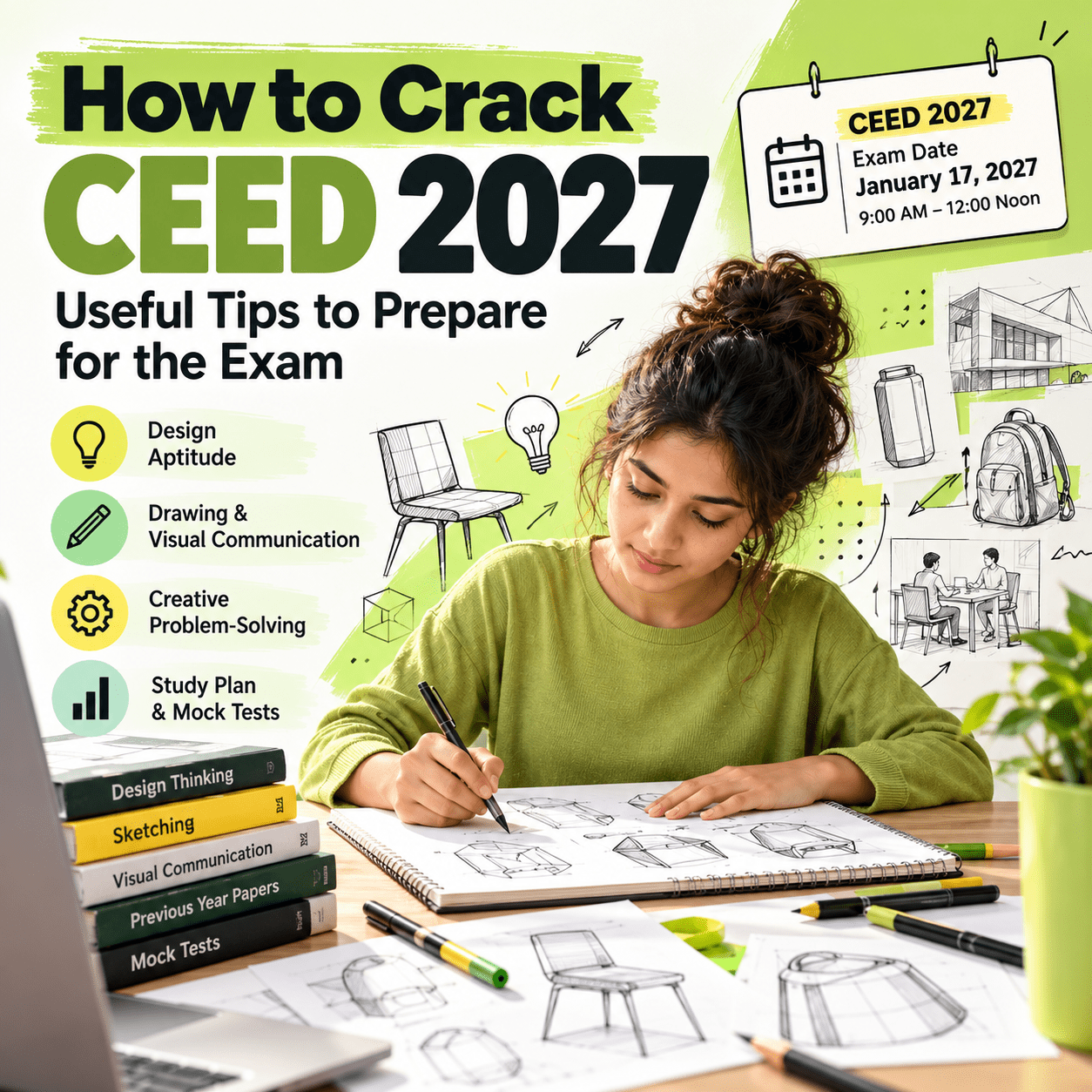
If you are wondering how to crack CEED 2027, the key is to understand the examination pattern, practise previous years’ question papers, develop your design thinking and evaluate your progress through regular mock tests.
In this guide, SILICA Institute shares practical CEED 2027 preparation tips, subject-wise strategies and a study plan to help you prepare effectively.
CEED 2027 Exam Overview
CEED is a national-level entrance examination conducted by IIT Bombay for admission to postgraduate design programmes at participating institutes. The examination evaluates candidates’ design aptitude, analytical abilities, visual perception and creative skills.
Before starting your preparation, understand the important examination details.
-
Examination name: Common Entrance Examination for Design (CEED)
-
Conducting institute: IIT Bombay
-
Examination date: January 17, 2027
-
Examination time: 9:00 AM to 12:00 noon
-
Examination format: Part A and Part B
-
Official website: https://www.ceed.iitb.ac.in/2027/
The regular registration deadline is October 31, 2026, and registration with a late fee is available until November 6, 2026, at 5:00 PM. Check the official website for the latest instructions and eligibility requirements.
Understand the CEED 2027 Exam Pattern
One of the first steps in learning how to crack CEED 2027 is understanding the examination structure and the skills tested in each section.
CEED Part A: Design Aptitude and Analytical Skills
Part A consists of objective-type questions, including Numerical Answer Type (NAT), Multiple Choice Question (MCQ) and Multiple Select Question (MSQ).
The questions assess areas such as:
-
Visual and spatial ability
-
Environmental and social awareness
-
Analytical and logical reasoning
-
Language and comprehension
-
Observation and design sensitivity
To prepare for Part A, solve aptitude questions regularly, practise visual reasoning exercises and develop the habit of observing everyday objects, patterns, spaces and visual information.
CEED Part B: Design, Drawing and Writing Skills
Part B evaluates your ability to communicate ideas through design, drawing and written responses. It includes five questions, with answers written in the answer book provided at the examination centre.
Focus on developing the following skills:
-
Sketching and visual communication
-
Perspective, proportion and composition
-
Creative problem-solving
-
User-centred design thinking
-
Design awareness and originality
-
Clear explanation of design concepts
According to the official CEED 2027 examination information, the final score is calculated using 25% of the Part A marks and 75% of the Part B marks. However, candidates must attempt both parts, and Part A qualifying requirements also apply.
10 Useful Tips to Crack CEED 2027
1. Understand the Syllabus and Question Format
Begin by reviewing the official CEED 2027 syllabus and information brochure. Understand the different question types, skills being evaluated and examination instructions.
Divide the syllabus into manageable topics and create a weekly preparation schedule. This will help you identify areas that need more attention and prevent you from spending too much time on a single topic.
2. Develop Strong Visual Observation Skills
Design aptitude involves observing details that people often overlook. Practise analysing everyday objects, advertisements, packaging, furniture, public spaces and user interfaces.
Ask yourself questions such as:
-
Why does this product have this particular shape?
-
How does its design improve usability?
-
Could the product be made more accessible or comfortable?
-
How could its appearance or functionality be improved?
These exercises help you develop a design-oriented approach to everyday problems.
3. Practise Sketching Every Day
Regular sketching can help you improve your drawing speed, proportions and visual communication.
Start with simple objects such as bottles, chairs, bags, shoes and household products. Gradually practise objects from different angles, basic perspective, human figures and scenes involving people interacting with their surroundings.
Focus on communicating an idea clearly rather than making every sketch look like a finished illustration.
4. Improve Your Creative Problem-Solving Skills
CEED preparation is not only about drawing. You must also learn how to identify problems and develop practical, original solutions.
Choose an everyday problem, such as carrying groceries comfortably or improving the usability of a public waiting area. Identify the user’s needs, brainstorm possible solutions and sketch your preferred design.
Practise explaining why your proposed solution is useful, feasible and suitable for the intended user.
5. Strengthen Logical and Analytical Reasoning
Solve questions involving patterns, sequences, spatial relationships, visual puzzles and logical reasoning.
Set aside a dedicated practice session every day. After solving a question, review your approach and understand why the correct answer works.
If you repeatedly make mistakes in a particular question type, revise the underlying concept before attempting more questions.
6. Solve Previous Years’ CEED Question Papers
Ceed Previous years question papers are valuable resources for understanding question formats and evaluating your preparation.
Attempt papers from recent examination years under timed conditions. After each attempt, review your answers, identify weak areas and record recurring mistakes.
Do not simply memorise answers. Focus on understanding the reasoning behind each solution and applying the same concepts to unfamiliar questions.
7. Practise Time Management
Time management is an important part of examination preparation. Allocate practice time according to the question type and the difficulty of each task.
During ceed mock tests, avoid spending too long on one difficult question. Practise deciding when to move forward and when to revisit a question.
Review your time allocation after every test and make improvements before your next attempt.
8. Build Your Design Awareness
Develop a habit of observing design in everyday life. Explore product design, furniture, architecture, packaging, graphic design, transportation and digital interfaces.
Learn about basic design principles such as balance, contrast, proportion, hierarchy, usability and accessibility.
When you encounter an interesting design, consider the problem it solves, the audience it serves and the decisions that make it effective.
9. Take Mock Tests and Analyse Your Performance
Mock tests help you practise under examination-like conditions and identify areas that require improvement.
After every mock test:
-
Review incorrect answers.
-
Identify topics that consume too much time.
-
Track your accuracy and completion rate.
-
Review drawing clarity and idea communication.
-
Plan revision sessions around your weaknesses.
Use your results to improve your preparation strategy instead of focusing only on the score.
10. Maintain Consistency and Revise Regularly
Consistent preparation is generally more effective than irregular, last-minute study sessions.
Create a realistic timetable that includes aptitude practice, sketching, design exercises, revision and mock tests. Keep a notebook of mistakes, useful design principles and concepts that require revision.
In the final weeks, focus on strengthening your existing skills and practising full-length papers rather than attempting to learn every topic from scratch.
How to Prepare for CEED Part A
A focused Part A preparation strategy should cover visual reasoning, analytical thinking, environmental awareness, language skills and design sensitivity.
Follow these steps:
-
Practise aptitude questions: Solve visual puzzles, logical reasoning exercises and spatial ability questions.
-
Improve observation: Study patterns, shapes, objects and their relationships.
-
Build general design awareness: Observe how design influences daily life, society and the environment.
-
Work on accuracy: Review mistakes and understand the concepts behind them.
-
Attempt timed tests: Practise managing time across different question types.
-
Revise regularly: Revisit difficult topics and maintain a record of recurring errors.
Always refer to the official syllabus for the precise scope of CEED 2027.
How to Improve CEED Part B Drawing Skills
Part B requires candidates to communicate design ideas effectively. A strong response should demonstrate an understanding of the problem, a suitable concept and clear visual communication.
Practise Perspective and Proportion
Start by sketching basic geometric forms and everyday objects. Practise drawing them from different viewpoints and maintaining consistent proportions.
Learn to Communicate Ideas Visually
Use clear sketches, appropriate annotations and a logical presentation of your concept. Avoid unnecessary details that make your main idea difficult to understand.
Focus on the User and the Problem
When answering a design question, identify who will use the proposed solution and what problem it addresses. Consider usability, comfort, accessibility and practical constraints.
Practise Under Time Limits
Complete drawing and design exercises within a fixed time. Review whether your sketches communicate the intended idea clearly and whether you have addressed the question completely.
Remember that drawing practice should support your design thinking. Decorative rendering alone is not a substitute for a relevant and well-developed solution.
CEED 2027: A Practical 30-Day Preparation Plan
If you have approximately one month remaining before the examination, use the following plan as a starting point. Adjust it according to your current skill level and available study time.
| Preparation period | Main focus | Recommended activities |
|---|---|---|
| Days 1–7 | Assess your skills | Review the syllabus, attempt a diagnostic paper and identify weak areas |
| Days 8–14 | Build core skills | Practise aptitude, visual reasoning, sketching and design problem-solving |
| Days 15–21 | Apply your knowledge | Solve previous years’ papers, attempt timed exercises and review mistakes |
| Days 22–26 | Mock tests | Attempt timed practice papers and analyse performance |
| Days 27–30 | Revision | Revise difficult concepts, practise selected drawing exercises and review exam instructions |
Try to maintain a daily routine that balances Part A and Part B preparation. Avoid neglecting either section, as both are important to your overall performance.
Common Mistakes to Avoid During CEED Preparation
Even well-prepared candidates can lose valuable practice time by following an ineffective strategy. Avoid these common mistakes:
-
Ignoring Part A or Part B: Prepare for both sections according to the official examination requirements.
-
Practising drawing without solving design problems: Combine sketching with observation, ideation and user-centred thinking.
-
Ignoring previous years’ papers: Use them to understand the question format and test your readiness.
-
Skipping mock-test analysis: Reviewing mistakes is essential for improvement.
-
Studying without a timetable: A structured schedule makes preparation easier to track.
-
Leaving revision until the last moment: Revise regularly throughout your preparation.
-
Relying on unverified exam information: Check official dates, syllabus details and instructions before making decisions.
How Can CEED Coaching Help with Your Preparation?
Preparing independently can work well for students who have a clear study plan and can evaluate their own progress. However, some candidates may benefit from structured guidance, regular practice and feedback on their work.
A suitable CEED coaching programme can help students organise their preparation, practise design aptitude questions, improve sketching and visual communication, and identify areas that need additional attention.
When selecting a coaching institute, consider the relevance of its curriculum, the quality of practice resources, the feedback provided on drawing and design exercises, the availability of mock tests and the suitability of the course schedule.
At SILICA Institute, students interested in design entrance preparation can explore the available CEED preparation options and choose a programme that suits their requirements.
Want to prepare for CEED 2027 with a structured study plan?
Explore the SILICA CEED Crash Course to learn more about the available preparation support.
Frequently Asked Questions About CEED 2027
1. How can I crack CEED 2027 on my first attempt?
Start by understanding the syllabus and exam pattern. Practise aptitude questions, sketch regularly, solve previous years’ papers, attempt mock tests and review your mistakes consistently. Focus on developing both analytical and creative problem-solving skills.
2. Is drawing important for CEED 2027?
Yes. Drawing and visual communication skills are important for Part B. Practise sketching, perspective, proportion, composition and communicating design ideas clearly. Also prepare for the analytical and aptitude skills assessed in Part A.
3. How many hours should I study daily for CEED?
Your study time depends on your current preparation level, drawing skills and familiarity with aptitude questions. Create a realistic timetable that allows you to practise both parts, revise difficult topics and complete mock tests regularly.
4. Are previous years’ question papers useful for CEED preparation?
Yes. They help you understand question formats, practise under timed conditions and identify your strengths and weaknesses. Review the solutions carefully rather than relying on memorisation.
5. Can I prepare for CEED 2027 without coaching?
Yes, self-study is possible if you follow the syllabus, use reliable resources and practise consistently. Coaching may provide additional structure, expert feedback and opportunities for guided practice, particularly for students who need help evaluating their design responses.
6. When will CEED 2027 be conducted?
The official CEED 2027 examination date is January 17, 2027, from 9:00 AM to 12:00 noon. Check the official CEED website for updates.
7. Does qualifying for CEED guarantee admission to an M.Des. programme?
No. Qualifying for CEED does not guarantee admission. Candidates must apply to their chosen institutes and satisfy their respective admission requirements, which may include additional selection stages.
Start Your CEED 2027 Preparation Today
Cracking CEED 2027 requires consistent practice, careful planning and a willingness to improve through feedback. Understand the exam pattern, strengthen your design aptitude, practise drawing and problem-solving, and use mock tests to measure your progress.
Start with a realistic study plan and focus on improving a little every day. With the right preparation strategy, you can approach the examination with greater confidence.
Explore CEED preparation at SILICA Institute and take the next step towards your design education goals.
Explore the SILICA CEED Crash Course | Visit the official CEED 2027 website
0 Comments