





Highest Toppers across India
in NID / NIFT 2023 were SILICA students
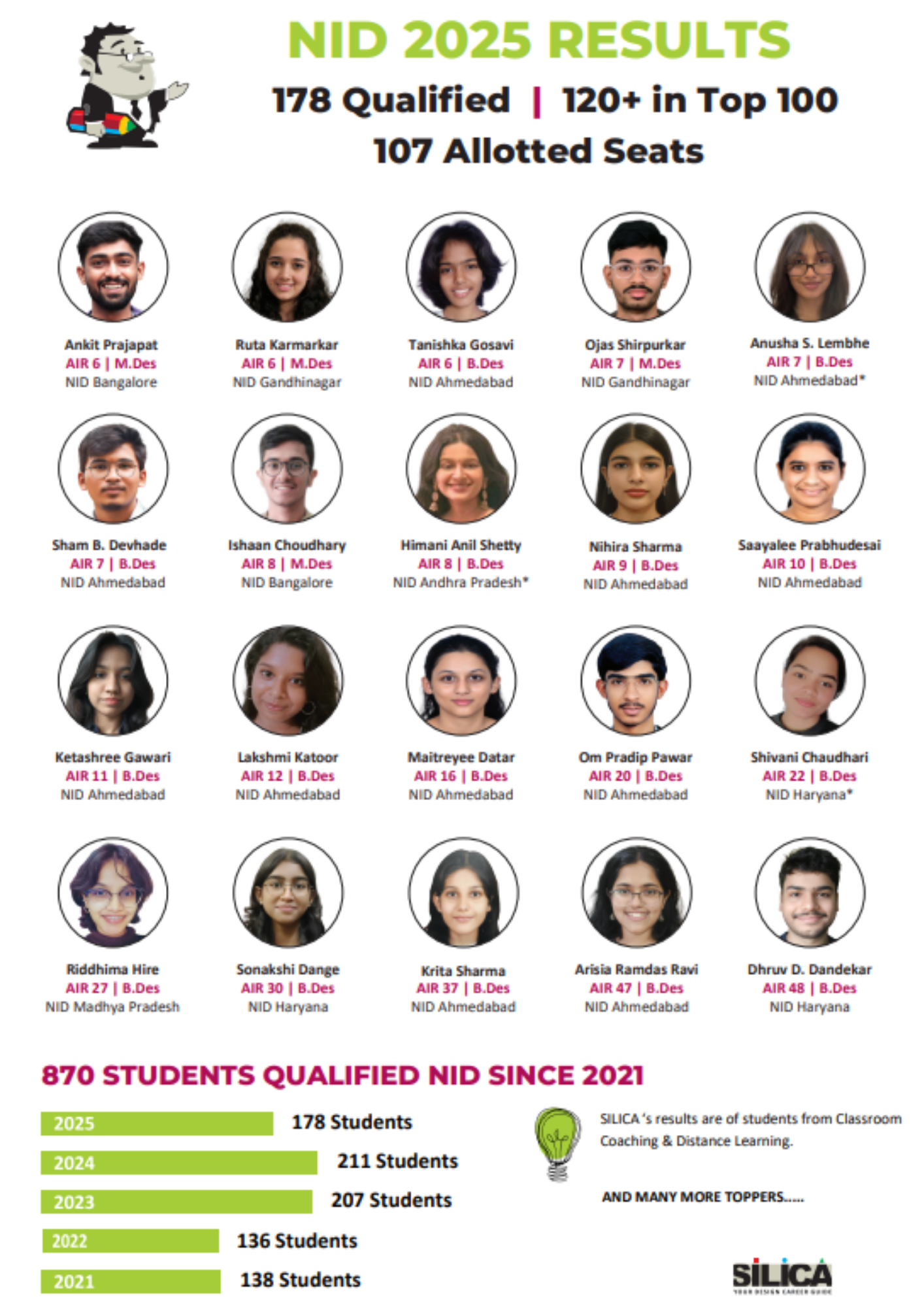
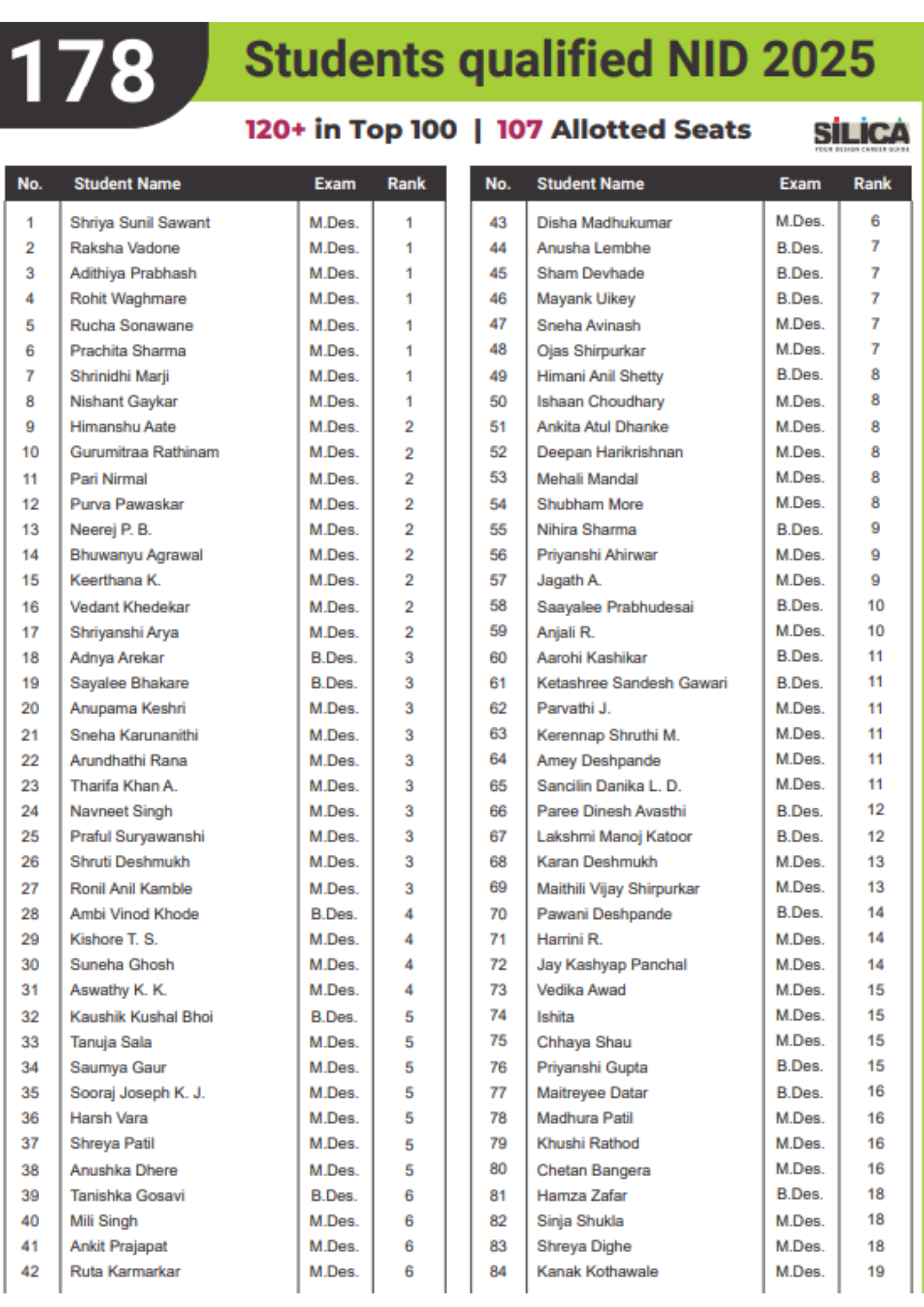
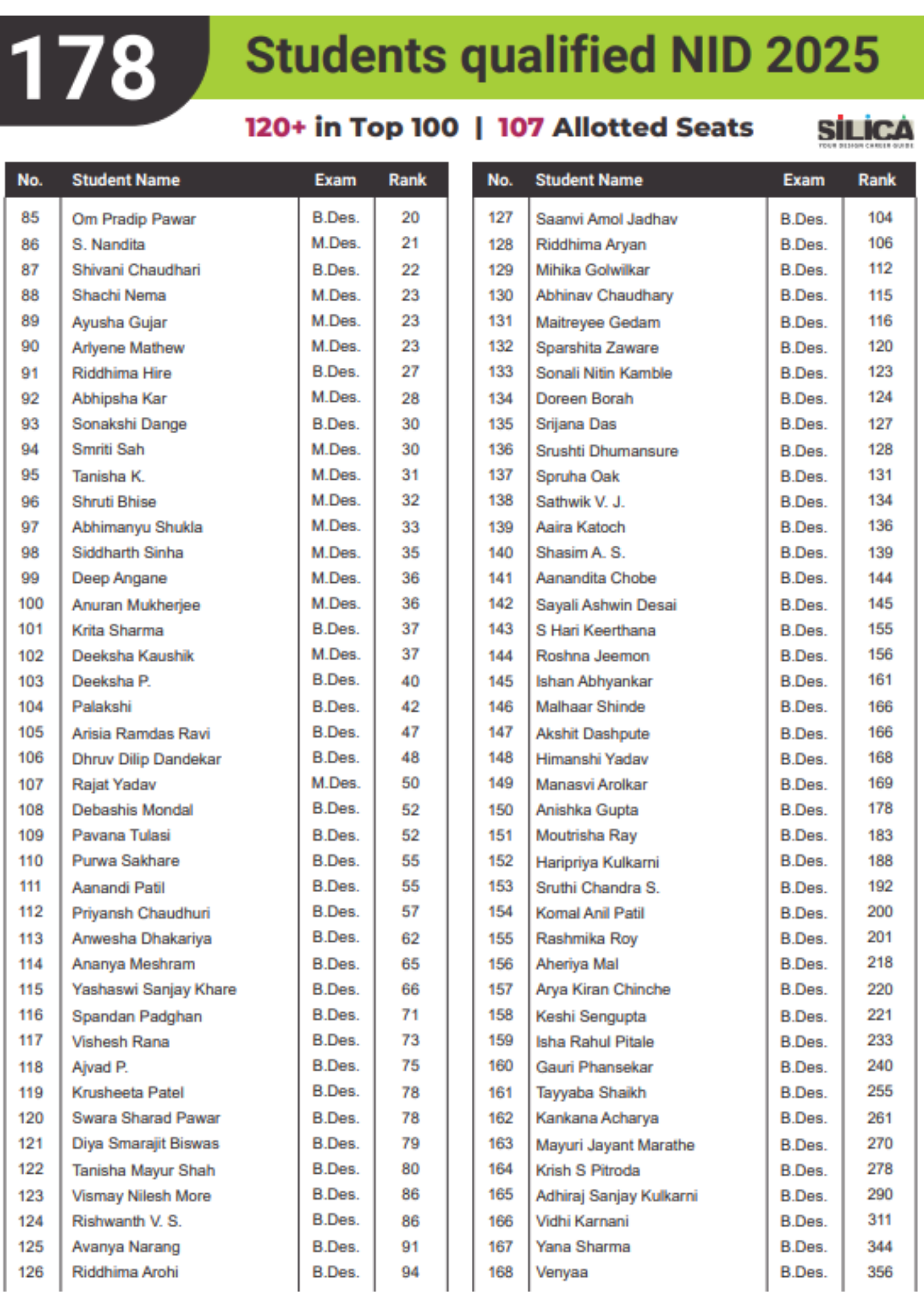
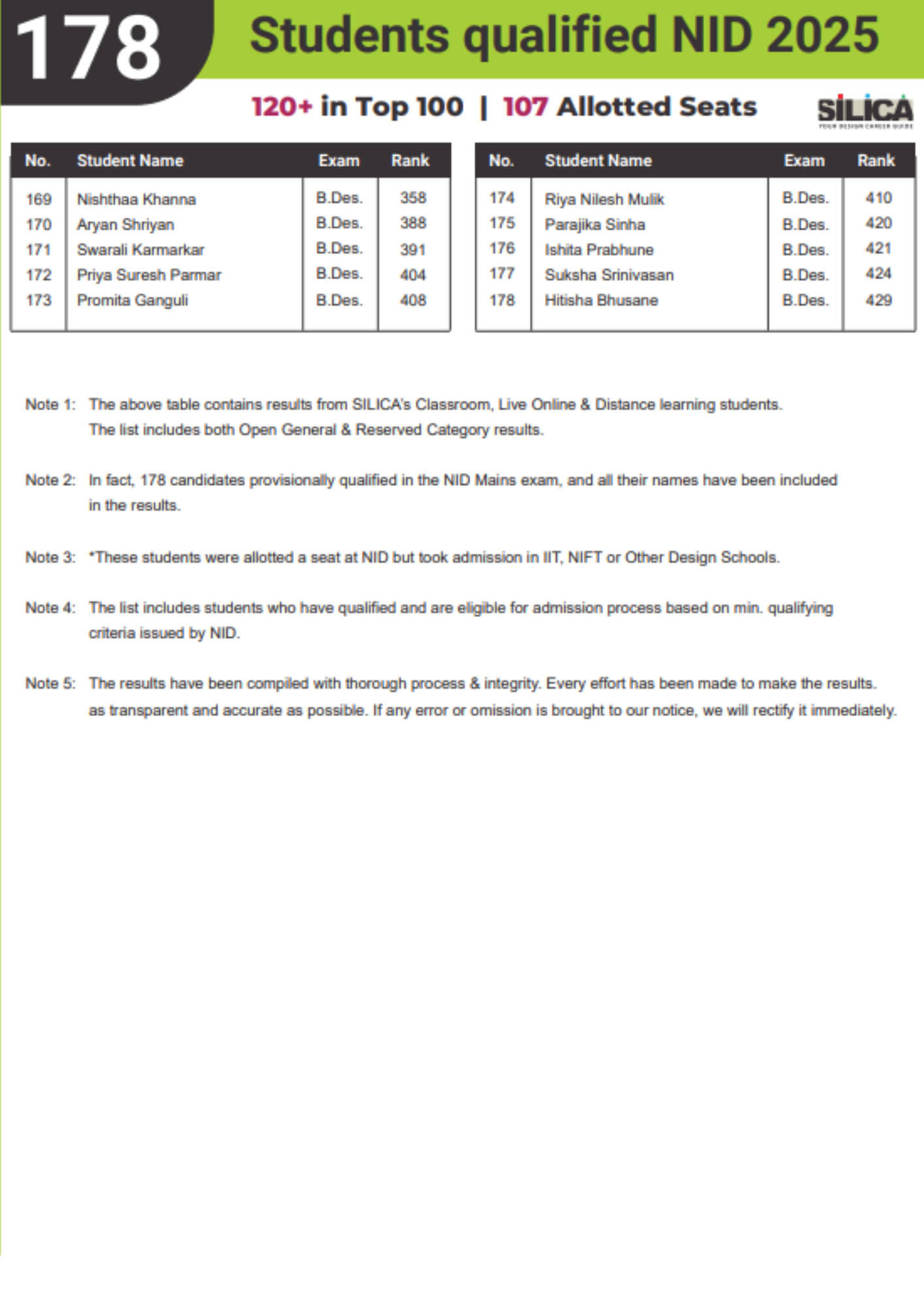
<178 Qualified NID 2025
120+ in top 100
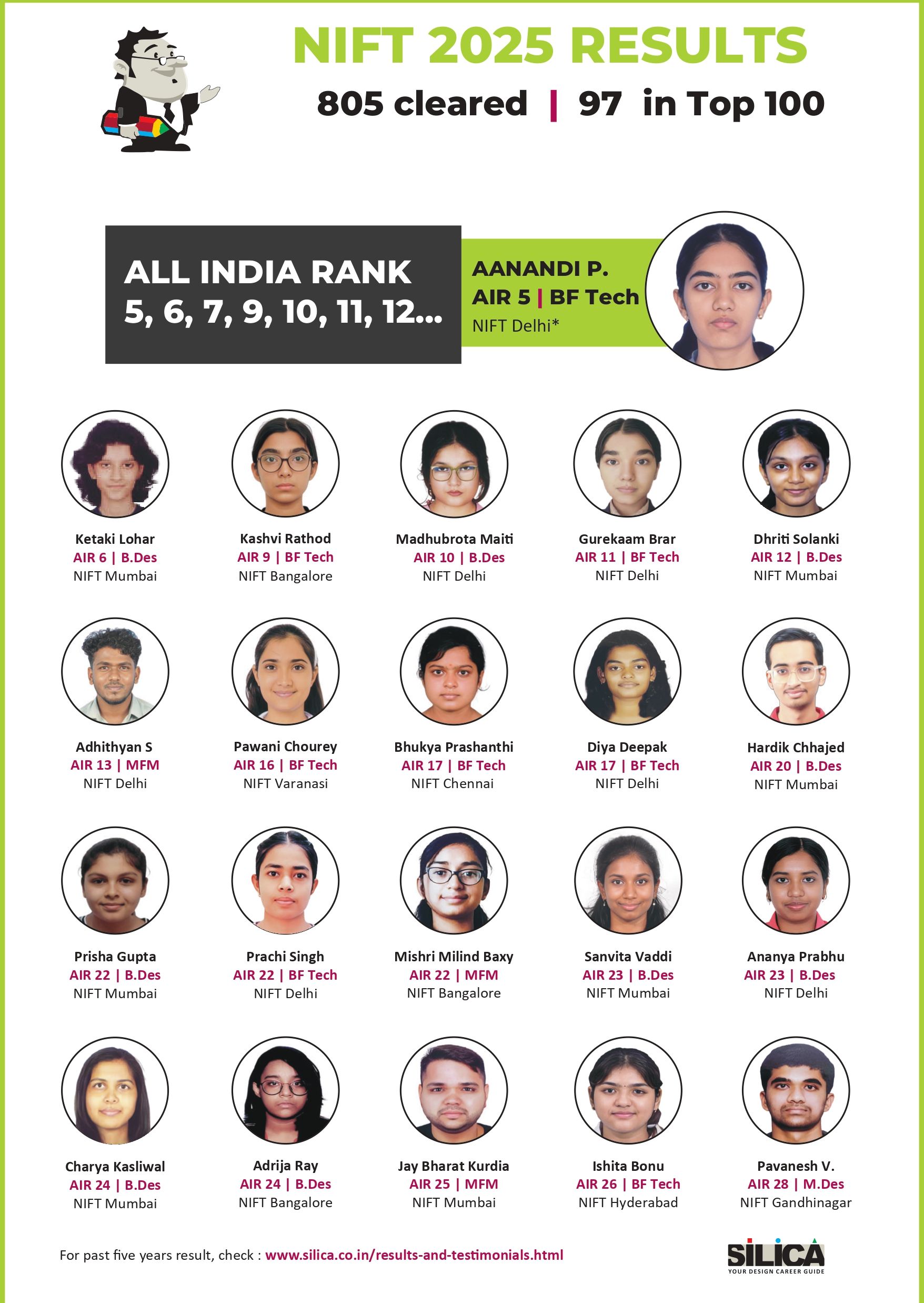
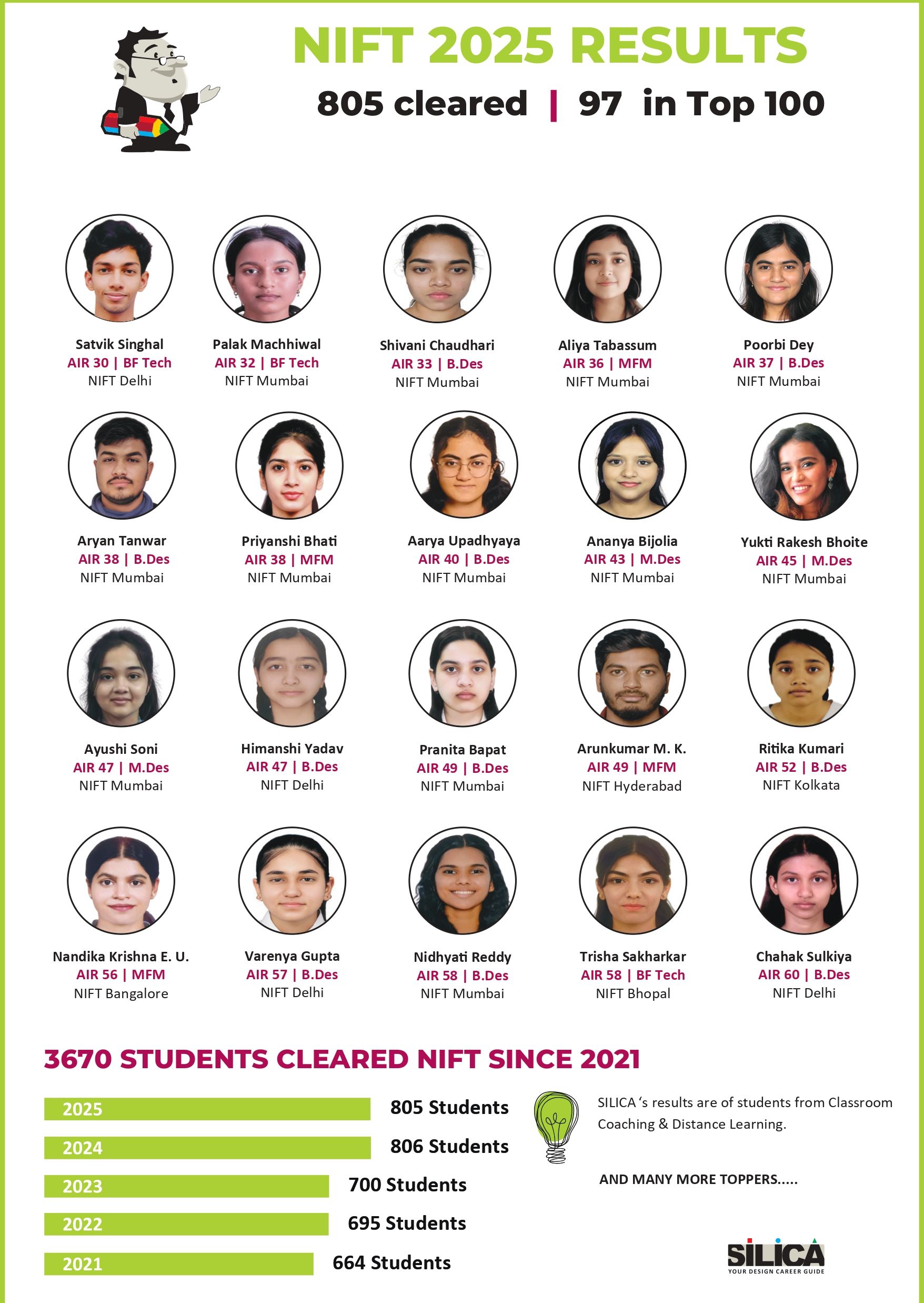
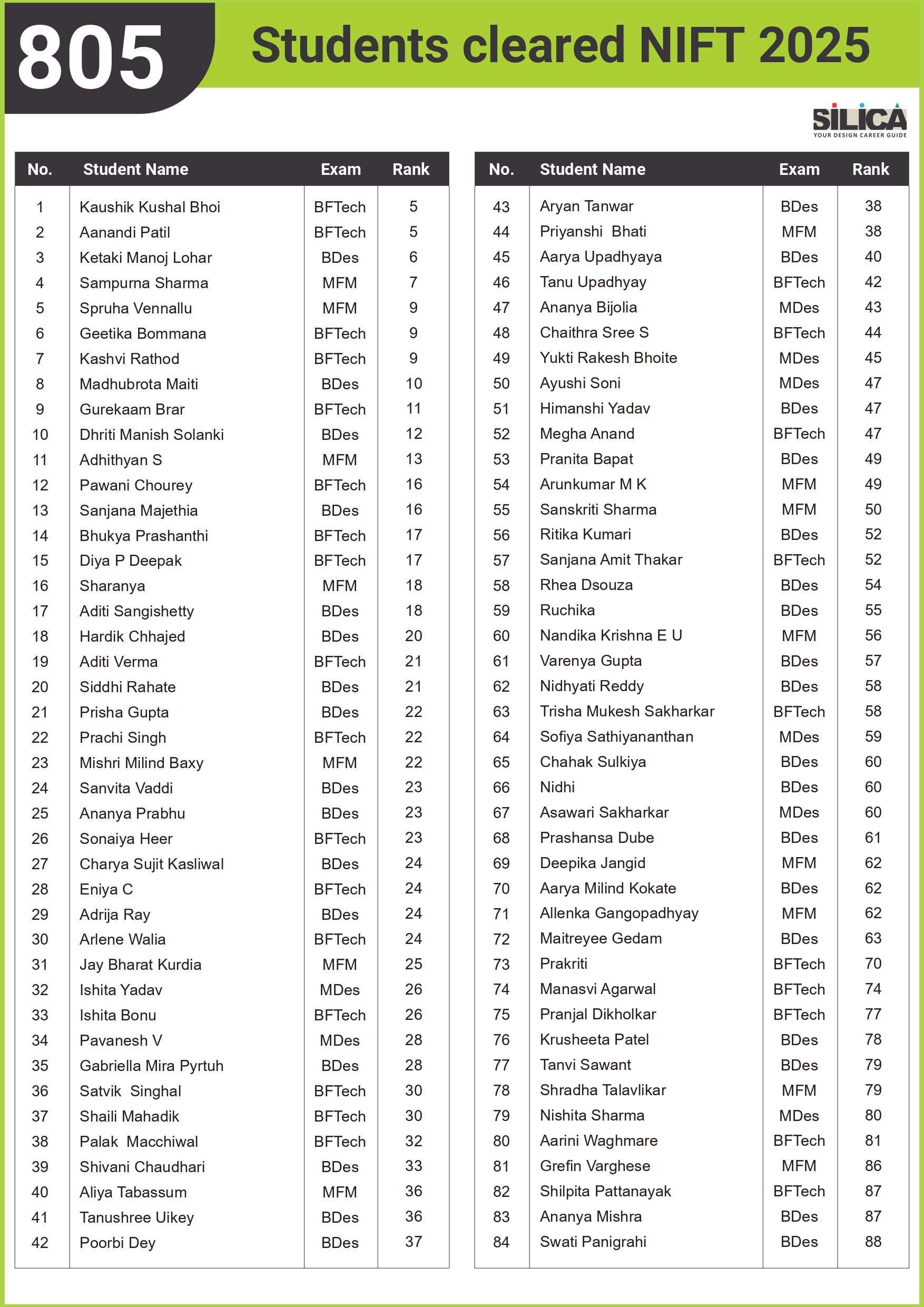
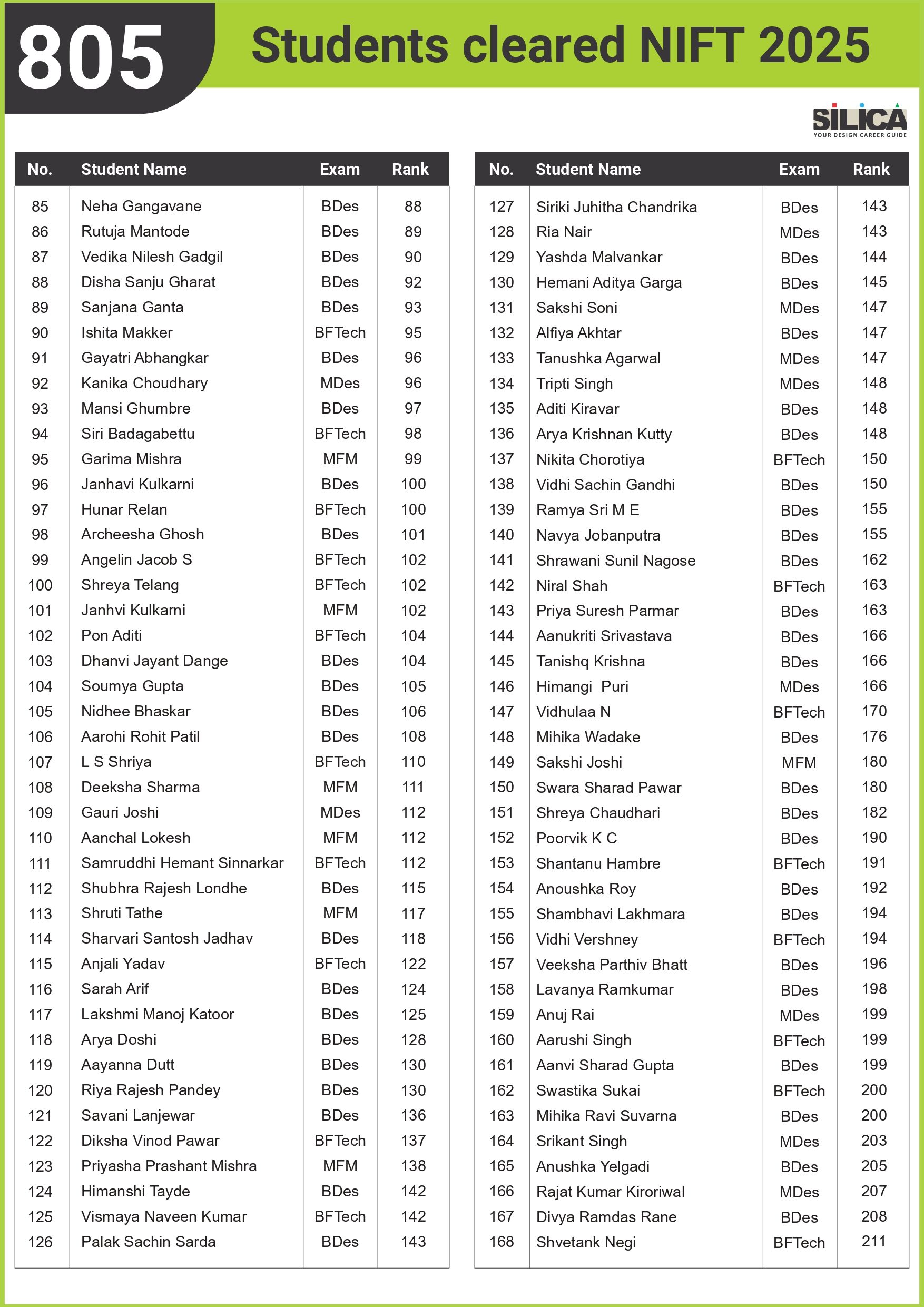
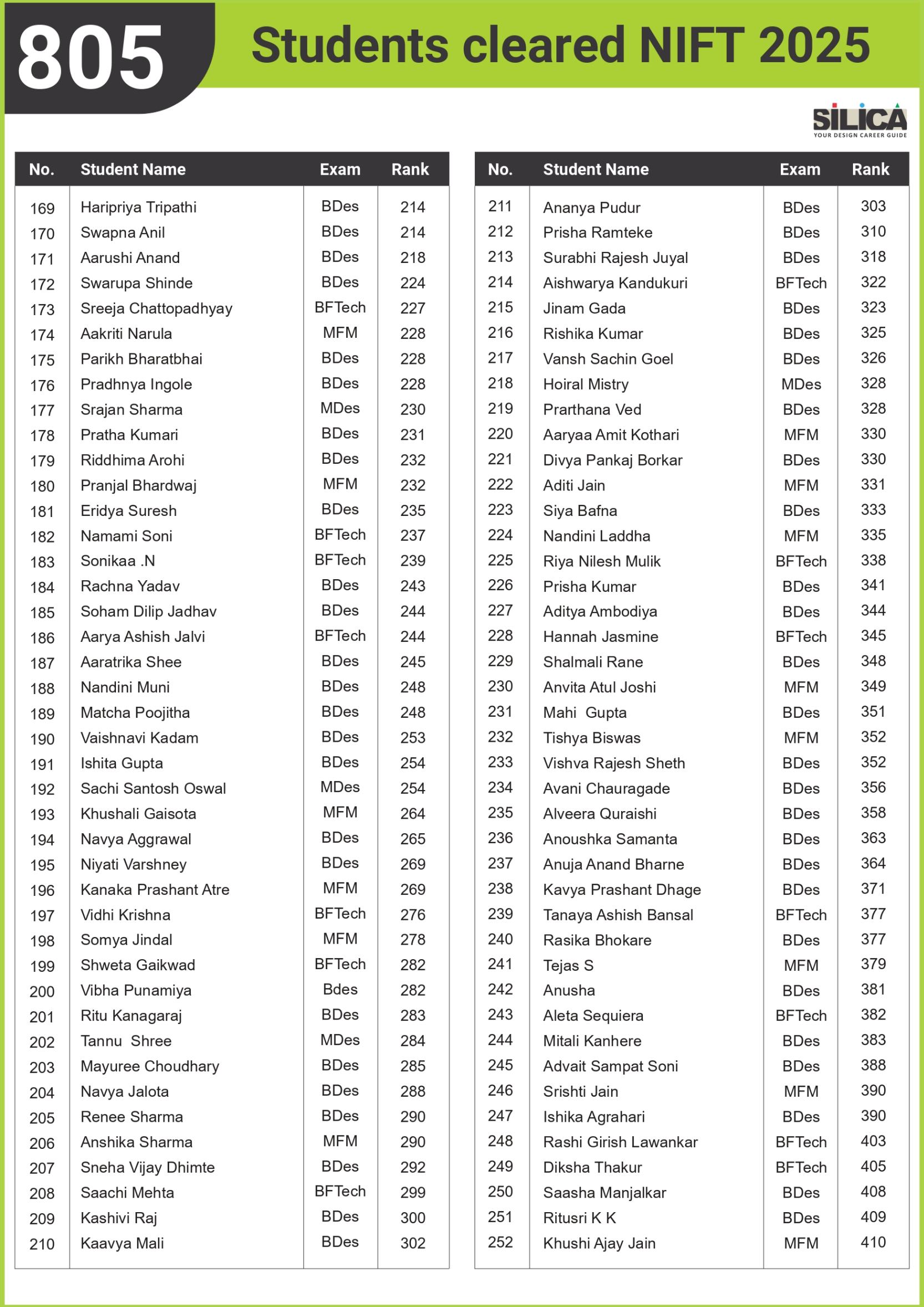
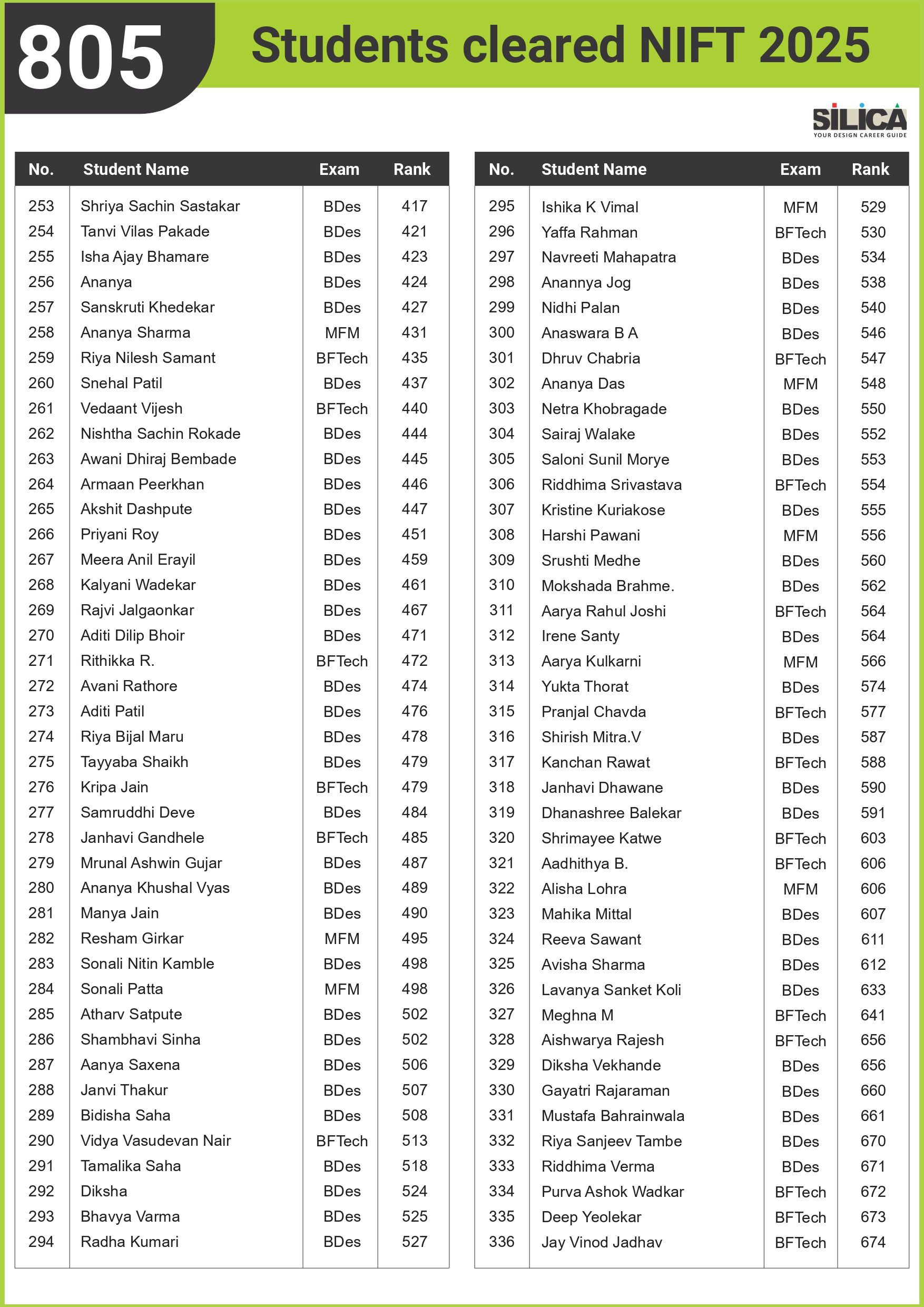
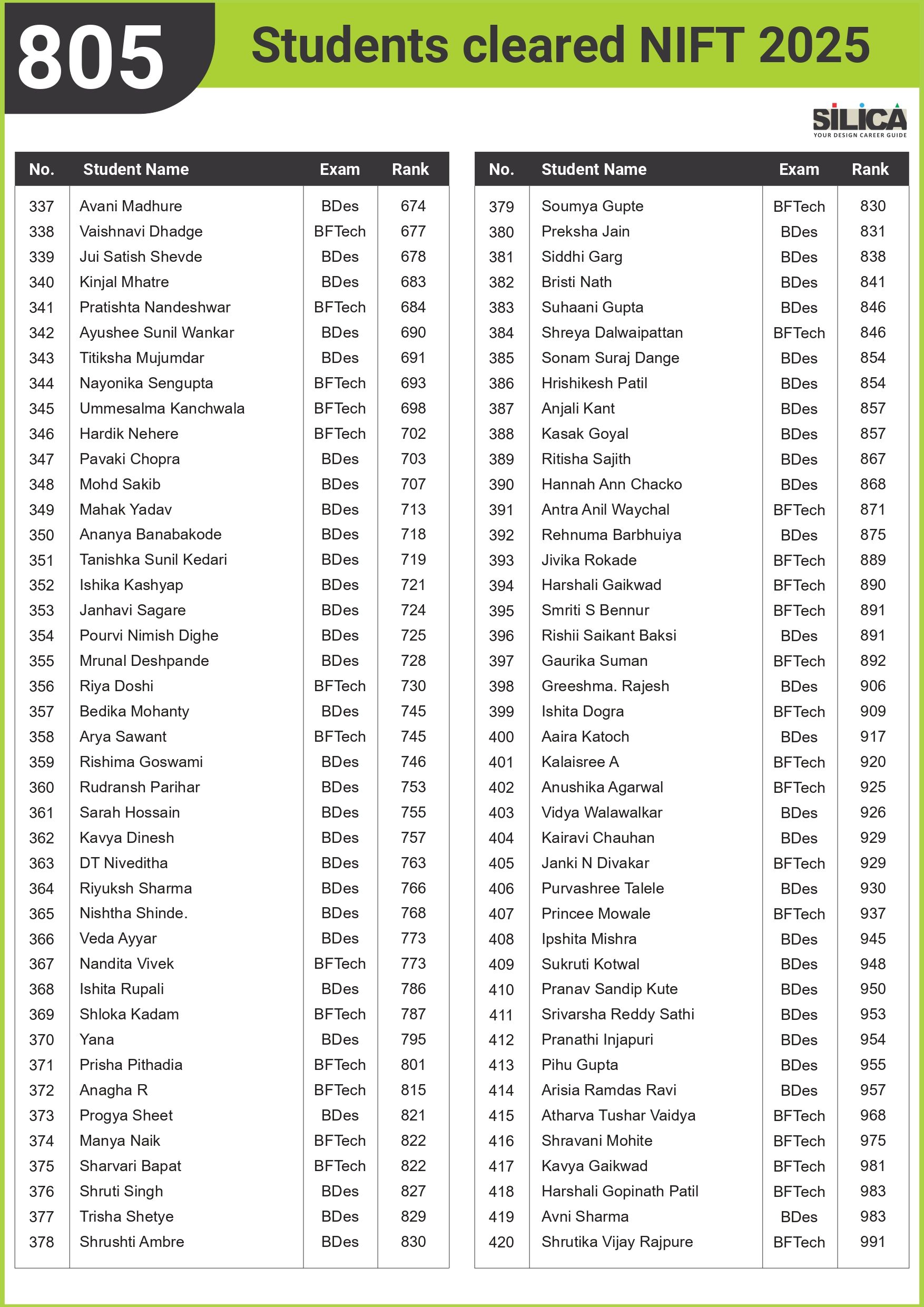
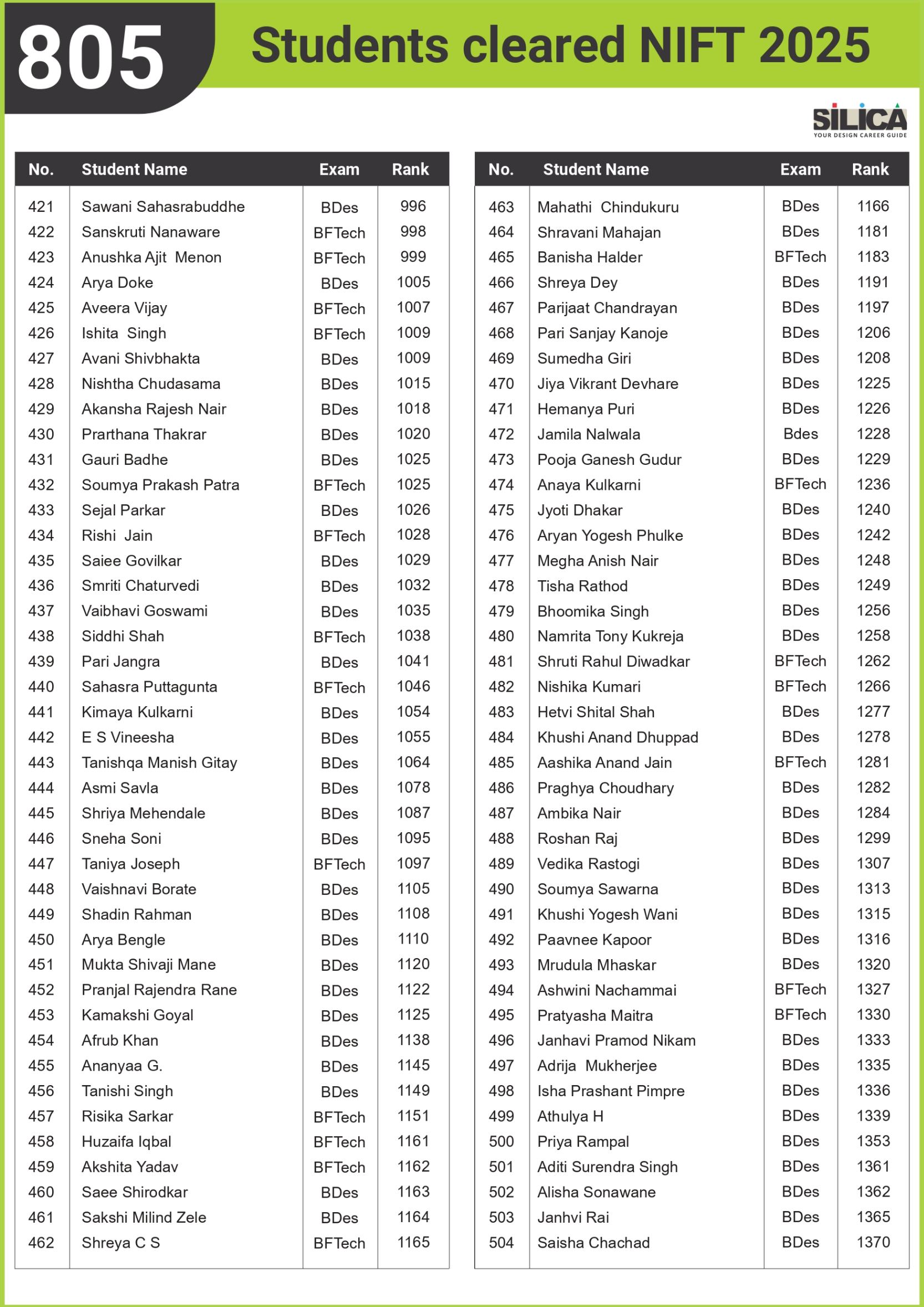
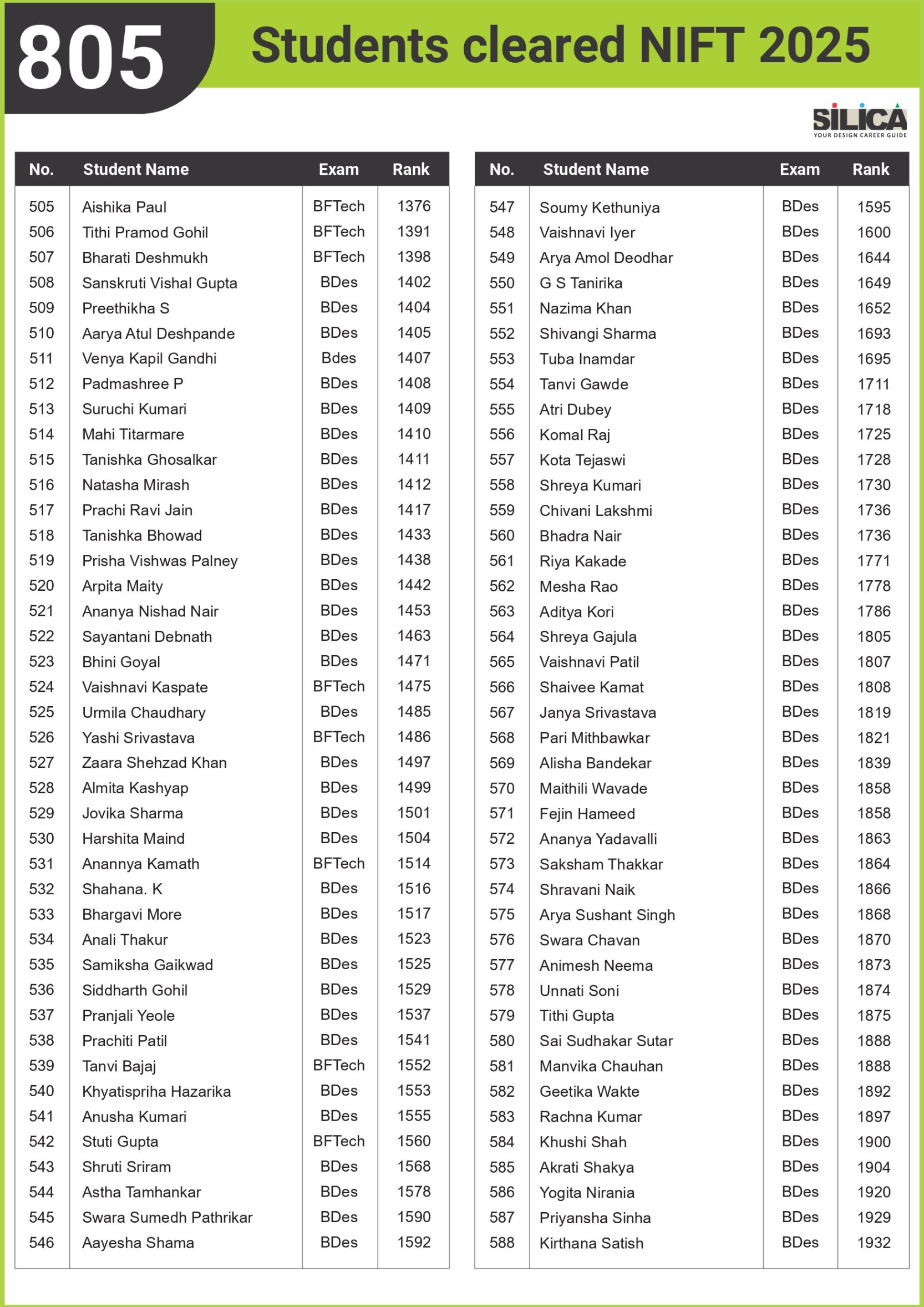
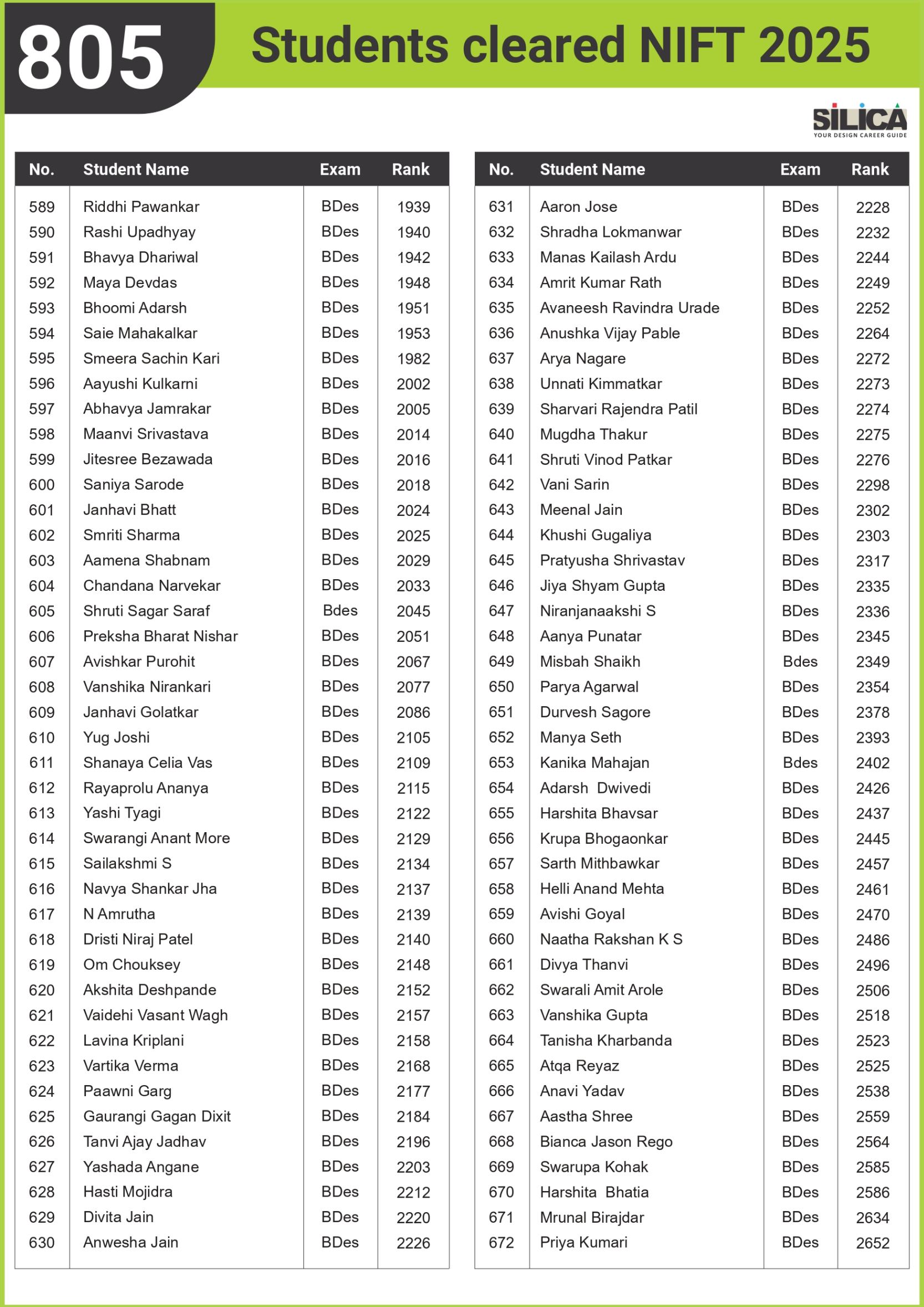
805 Cleared NIFT 2025
97 in Top 100
View Full ResultsEnquire for Coaching
NID / NIFT Coaching 2026 / 2027 Attempt
SILICA is a Guide, not just a Coaching class! SILICA will help
you at every stage of your architecture journey.
1. Before you Start
We scientifically check your Aptitude & Passion for Design.
2. Ace Coaching
with Top Faculties, Online App, Study Books, Weekly Tests.
3. After Your Course
Personal Guidance for admission and college decisions.
Offline Coaching across all Centers
Entrance Exam Coaching for 2026 & 2027 Attempt
Attend a Free Demo ClassFree Download PDFs
Download free PDFs / Videos created by our expert Faculties.
 All About NID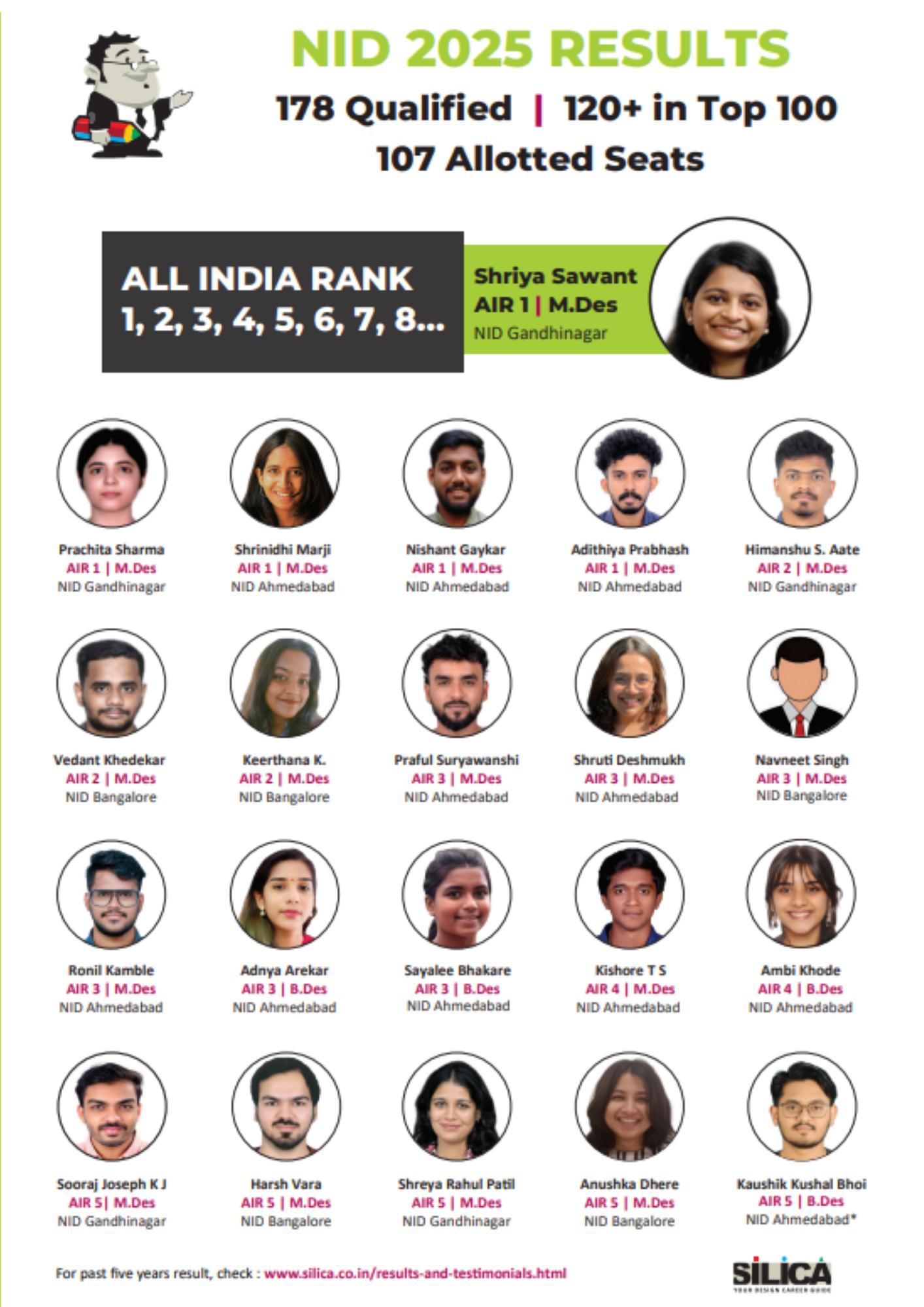
SILICA has 28 Coaching Centers in 9 Cities
SILICA Institute
Law College Road
2nd Floor, Reverie Apts, Survey No. 805, Bhandarkar Road, Above Skoda Showroom, Deccan, Pune - 411 004
Mahatma Gandhi Road
2nd Floor, Shan Hira Building, Near Canara Bank, Above Titan Showroom M. G. Rd Camp, Pune - 411 001
Pimpri Chinchwad
Office No 76, 5th Floor Kunal Plaza, Near Chinchwad Station, Mumbai - Pune Highway Road Chinchwad , Pune - 411 019
Baner
3rd Floor, Shri Ram Yashoda, SNO 79/1, Next to Orchid School, Balewadi Phata, Baner , Pune - 411 045
Viman Nagar
Office No. 3, Aswani Chambers, Third Floor Viman Nagar Rd, 411014, Sainik Nagar, Clover Park, Pune, Maharashtra 411014
Kothrud
6th Floor, office no. 604,605 Swojas one Next to Reliance Digital Paud Road, Kothrud, Pune, Maharashtra- 411038
Sinhagad Road
4th Floor, Vasant Vaishali, Above Pizza Hut, Next to Santosh Hall Narveer Tanaji Malusare Road, Arvind Society, Anand Nagar, Pune, Maharashtra-411051

Frequently Asked Questions
- About NID
- About NIFT
-
1. What is National Institute of Design (NID)?
NID (National Institute of Design) is internationally acclaimed as one of the finest educational and research/ institutions for Industrial Design, Communication Design, Fashion Design, IT Integrated Design & Inter-Disciplinary Design Studies at both graduate and post-graduate level.
It is listed as no. 1 design institute in Asia and listed in top 25 design institutes in Europe-Asia. National Institute of Design is an Institute of National Importance by NID Act 2014 and an autonomous Institute under the DIPP, Ministry of Commerce & Industry, Government of India (just like the IITs).
NID has 8 campuses in Ahmedabad, Gandhinagar, Bengaluru, Vijayawada, Kurukshetra, Bhopal, Andhra Pradesh & Assam
-
2. What programs does NID offer?
- NID offers 4 years B.Des. program in 8 design disciplines at its main campus in Ahmedabad (125 seats).
- From 2020 onwards NID offers 4 years B.Des program in 3 design disciplines at its new campuses in Vijayawada, Kurukshetra, Bhopal & Jorhat (75 seats each = 300 seats).
- NID offers 2.5 years M.Des. program in 19 design disciplines at its campuses in Ahmedabad, Gandhinagar & Bengaluru (347 seats).
-
3. What is the eligibility for admission to NID?
For B.Des. programs:
Criterion 1: Age Limit - Candidate is 20 years of age before 1st July (relaxable for up to 3 years for reserved category)
Criterion 2: Educational Qualification - Candidate should have passed or been appearing for 10+2 exam from any recognized board.
Note 1- Candidates completing a 10+3 technical diploma are no longer eligible for applying.
For M.Des. programs:
Criterion 1: Age Limit - Candidate is 30 years of age before 1st July (relaxable for up to 3 years for reserved category)
Criterion 2: Educational Qualification - Candidate should have passed from any recognized institute or university any of the following:
- Bachelor's degree in any discipline under 10+2+4 system
- Bachelor's degree in any discipline under 10+2+3 system with one year experience or further academic qualification
- Diploma in Design under 10+2+4 system
Note 2 - Candidates who are appearing for their final year of 10+2+3 bachelors are no longer eligible to apply.
-
4. What is NID’s admission process?
Admission is on the basis of NID’s method of selection, which extends beyond the student’s previous academic qualifications. The objective of the admission process is to seek evidence of the perception, attitude, aptitude, achievement and motivation essential in a potential design student. The process of Admission to NID for B.Des. and M.Des. programs consists of 2 phases of Design Aptitude Tests (DAT):
Phase 1: DAT (Prelims)
Phase 2: DAT (Mains)
-
5. What is the pattern of the NID entrance exam?
Stage 1: Design Aptitude Test (DAT) - Prelims (B.Des)
- The DAT Prelims is a written exam for 3 hours for 100 marks. It has 2 sections -
- Section 1 - Objective Type Questions
- Section 2 - Subjective Type Questions
- There is no fixed weightage for the 2 sections. It varies from year to year. The weightage for last 4 years is as follows:
- The DAT prelims is a screening test for Stage 2.
- The DAT prelims score is expected to carry 20% weightage in final score.
# Sections Marks for each Section 2021 2020 2019 2018 2017 2016 1 Objective Section 40 30 30 70 70 70 2 Subjective Section 60 70 70 30 30 30 Total Marks 100 100 100 100 100 100 Stage 2: Design Aptitude Test (DAT) - Mains
- Based on the scores obtained in the DAT Prelims, eligible candidates will have to appear for the DAT Mains.
- Generally, candidates equal to 3 times the number of seats are called for DAT Mains.
- The DAT Mains will be for about 3 hours and 100 marks and will consist of Studio Test & Interview*.
- Candidates get a final merit score and merit rank based on marks obtained in DAT Prelims and NID Mains. The weightage given to marks at each stage is:
Stage of Exam BDes MDes Stage 1: NID DAT Prelims 30% 20% Stage 2: NID DAT Mains 70% 80% Total % 100% 100% - The DAT Prelims is a written exam for 3 hours for 100 marks. It has 2 sections -
-
6. What is the exam syllabus of / questions asked in for NID DAT Prelims?
The DAT Prelims is a written exam for 3 hours for 100 marks. It has 2 sections- Objective & Subjective. The syllabus in each section is as follows:
1. Objective Section: All questions are Multiple Choice Questions (MCQ). The candidates have to answer on an OMR marking sheet. There is no negative marking. The weightage of this section in the paper can vary from 30 marks to 70 marks. The subjects and their expected weightage is (this is not fixed, can change):
Subject Expected Weightage 1. Logical & Critical Thinking 30% 2. General Knowledge & Current Affairs 25% 3. Design Aptitude & Sensitivity 20% 4. English Communication & Comprehension 15% 5. Quantitative Ability 10% Total Marks → 100% 2. Subjective Section: These are questions where the candidates have to answer in the form of drawing, coloring and writing. The questions can be based on Object / Product Drawing, Communication Design, Situational Visualization & Drawing, Color Compositions, Everyday Problem Solving, Creative Writing, Abstract / Imaginative Thinking etc.
The answers to these questions are assessed on the basis of:
- The Idea or Concept: How creative, unique, interesting, sensible the idea or concept of the answer is.
- The Presentation: How good the visualization, technical drawing, coloring, presentation quality is.
-
7. What questions are asked in the NID DAT Mains exam?
Phase 2: DAT (Mains)
On the basis of the DAT Prelims score, candidates are shortlisted and called for DAT Mains. The DAT Mains for this programme consists of two parts:
- Studio Test: This may consist of tests in different formats such as drawing / sketching, hands-on model making, group discussions, presentations etc. This test will be marked out of 100 marks and will be conducted in English. The DAT Mains for NID MDes will include questions relating to the design discipline applied for by the candidate.
- Interviews (only for MDes): The interviews will be conducted separately for each discipline, immediately after the Studio Test, at the same centre. The candidates may be asked to present their design portfolio as part of the interview.
Note 1 - The weightage of each test in the NID Mains is decided every year by the NID Admission Cell, but is generally Studio Test (70%) and Interview (30%).
-
8. What are the important dates in NID admission process?
These are the important dates in the admission process of the National Institute of Design:
Event Date Online Application Form available 5th Oct 2021 Last date of Online Application 4 pm on Tuesday, 30th Nov 2021 Last date of Online Application with late fees 4 pm on Sunday, 5th Dec 2021 DAT (Prelims) Sunday, 2nd Jan 2022 -
9. Where is the NID entrance exam held?
DAT (Prelims) will be conducted in the following 16 cities in India: Ahmedabad, Bengaluru, Bhopal, Chandigarh, Chennai, Dehradun, Guwahati, Hyderabad, Kolkata, Lucknow, Mumbai, Nagpur, New Delhi, Ranchi, Thiruvananthapuram, and Vijayawada.
The DAT (Mains) are conducted in the different NID campuses
-
10. What is the passing score / cut off for selection for NID DAT Prelims? What is the expected cut off for NID DAT Prelims 2021?
There is no fixed passing score / cut off for NID DAT Prelims. It varies from year to year. Generally, candidates equal to 3 times the no of seats available are shortlisted for DAT Mains. The cut off marks are based on that year’s students performance in DAT Prelims.
Past year cut offs for NID DAT BDes Prelims were as follows:
Year Open OBC-NCL SC ST Open-PH 2021 50 45 40 40 40 2020 65 65 55 45 45 2019 67 60 55.68 53.20 47.10 2018 68.10 59.50 55.50 52.50 48.00 2017 67.00 58.50 56.00 48.00 50.00 2016 60.00 53.00 50.00 48.00 52.00 The cut offs for NID DAT MDes Prelims are different for each discipline and ranges 55 to 75.
-
11. What is the passing score / cut off for NID DAT Mains? What is the expected cut off for NID DAT Mains 2021?
There is no fixed cut off / passing score for NID DAT Mains. The passing score varies from year to year. Click here for the cut off for NID DAT Mains in 2021.
-
12. What is the placement record for NID graduates & post-graduates?
NID has a very strong Industry Interface & Placement process. The Industry Interface is maintained in 3 different ways -
- Sponsored classroom projects - 4 to 8 week projects conducted for industry in last 2 years of UG and 2nd year of PG program.
- Mandatory Industrial training - 6 to 8 weeks project in the industry premises. Students are paid anywhere from 10,000 to 25,000 per month. This is scheduled during 3rd year of UG and 2nd year of PG program.
- Mandatory Diploma project - all final semester students need to complete 6 months of diploma project with a client organization. The stipend is anywhere from 15,000 to 50,000 per month.
Every year in December, NID conducts a placement week, where over 100+ recruiting companies float 1,000+ job offers for the last semester students. Almost 90% of the participating students are placed during this week.
Highlights:
- The highest salary offer to an NID post graduate in 2018 placement week was Rs 72 lacs p.a.
- The highest salary offer to an NID graduate in 2018 placement week was Rs 48 lacs p.a.
- The average salary offered to NID both batches in 2018 was Rs 15 lacs p.a.
- There was a 40% growth in recruiters and job offers.
-
13. What are the fees for programs at NID?
The yearly expense of studying and living at NID campus is as follows:
Yearly Expenses B.Des. M.Des. Tuition Fees 3,20,250 3,72,800 Hostel charges 30,000 30,000 Mess charges Informed in the beginning of each year Informed in the beginning of each year Total 3,50,250 4,02,800 Note: The above fees are for the academic year 2022-23. The fees are expected to rise 5%-7% every year, during the next 3 years (2022-23, 2023-24, 2024-25).
-
14. How do you apply to NID?
The application process for NID is online and starts in October every year. To apply, visit https://admissions.nid.edu/NIDA2022/Registration.aspx. The application process is in 5 easy steps:
Step 0: Read the admission brochure and instructions carefully
Step 1: Sign up and register
Step 2: Fill Details in Application Form
Step 3: Upload documents
Step 4: Pay Application Fee & Print your Application
-
15. What is the medium of instruction at NID?
The medium of instruction at NID is English. The language for NID DAT Prelims, Mains and the Interview is also English.
-
16. Does NID have residential / hostel accomodation facility?
Ahmedabad campus: Hostel accommodation is available only for B.Des. students from Sem 1 to 7.
Gandhinagar campus: Hostel accommodation is available for M.Des. students from Sem 1 to 4.
Bengaluru campus: Hostel accommodation is not available.
Vijaywada / Kurukshetra / Bhopal / Jorhat campus: Hostel accommodation is available for all GDPD students.
-
17. How is an NID admission Interview conducted?
NID admission interview is conducted by a panel of 3-4 persons. There are faculties and a psycho-analyst amongst them. The interview revolves around the candidate’s personality, interests, likes, dislikes, reactions to situations, their portfolio, their abilities etc. The interview questions can never be predicted. The length of the interview can never be predicted. It can be 2 minutes long or 1 hour long. The students may be asked about their design portfolio in the interview.
-
18. What kind of questions are asked in the NID admission interview?
There is no standard list of questions which are asked in a design admission interview. The questions will revolve around the candidate’s life, personality, temperament, achievements and creative outputs till date.
Some sample questions are:
- Why do you want to join NID? What will you do if you don’t get into NID?
- What would you do if you find a homeless person on the street shivering in cold?
- In one minute, tell us why we should select you at NID?
- You have one minute, make us laugh.
- For M.Des. (E.g. Product Design):
- Who is your favorite Product Designer?
- What are some of the new products that fascinate you? Why?
- What is happening in the Indian Product Design industry?
-
19. What student design portfolio is required for NID?
A design portfolio is not mandatory for admission to NID, but it helps the interviewer in assessing the suitability of the candidate for NID. During the interview, the candidate may present their past work (academic and/or professional) such as drawings, photographs, models, relevant documents etc., which they may like to share with the interview panel. These may be in analogue or digital (in a USB drive or your own laptop) format. The portfolio should reflect the candidate’s interests and abilities.
-
1. What is NIFT?
NIFT (National Institute of Fashion Technology) was set up in New Delhi in 1986 under the aegis of Ministry of Textiles, Govt. of India. Over the last 30 years, it has emerged as the premier educational institute for graduate and postgraduate programs in Fashion Design, Technology & Management. It has 16 campuses across India.
Website: www.nift.ac.in
Contact: Phone: Tel: +91-11-26542000 (Mon to Fri, 9.30am to 5.30pm)
Email: director.ho@nift.ac.in
Information about all campuses can be found at: http://nift.ac.in/
-
2. What programs does NIFT offer in 2022?
NIFT offers the following programs in Fashion Design, Technology and Management through its 17 campuses across India.
Programs at NIFT Regular NRI Domicile Total Seats Bachelors programs (4 years): 1. B.Des.* 2517 299 222 3038 2. B.F.Tech 433 50 35 518 Masters programs (2 years): 1. M.Des. (Design Space) 146 18 7 171 2. M.F.Tech. 540 61 49 650 3. M.F.Management 124 16 - 140 Note: 6 different specializations are offered under B.Des program i.e. Apparel, Accessory, Textile, Communication, Leather & Knitwear Design.
-
3. What are the eligibility criteria for admission to NIFT in 2022?
Educational Criteria:
For B.Des. programs: Passed or appearing for 10+2 exam from any recognized board or 10+3 or 4 diploma from any branch of engineering recognized by AICTE or State Technical Board.
For B.F.Tech program: Passed or appearing for 10+2 exam (with Physics, Chemistry & Maths subjects) from any recognized board or 10+3 or 4 diploma from any branch of engineering recognized by AICTE or State Technical Board.
For M.Des. / M.F.M. program: Passed or appearing for final semester of Bachelor Degree from any Institute / University recognised by law in India or Diploma of minimum 3 years duration in UG Design from NIFT / NID.
For M.F.Tech program: Passed or appearing for final semester of B.F.Tech. from NIFT or B.E. / B.Tech. from any Institute / University recognized by law in India.
Age Criteria:
For B.Des./B.F.Tech: Maximum Age eligible age is 23 years as on 1 October of previous year. I.e. on 1 October 2021 for 2022 attempt.
For M.Des./M.F.Tech/M.F.M: No Age Limit.
-
4. What is the pattern of the NIFT 2022 entrance exam? What is the weightage for different parts of the exam?
Admission to NIFT’s programs are on the basis of eligibility criteria and passing the different tests in the NIFT entrance examination. The CAT & GAT papers are written tests. The Situation Test & GDPI are practical tests. The weightage assigned to each test in the final merit list is given below:
Bachelors Programs:
Programs Test Type Test Duration Test Time Weightage B.Des. CAT (Creative Ability Test) 3 hours January 50% GAT (General Ability Test) 2 hours January 30% Situation Test 2 hours April 20% B.F.Tech GAT (General Ability Test) 3 hours January 100% Masters Programs:
Programs Test Type Test Duration Test Time Weightage M.Des. CAT (Creative Ability Test) 3 hours January 40% GAT (General Ability Test) 2 hours January 30% GD / Personal Interview - May 30% M.F.M. / M.F.Tech GAT (General Ability Test) 3 hours January 70% GD / Personal Interview - May 30% P.S.1 - There is no interview for admission to NIFT Bachelors programs
P.S.2 - Based on results of all the tests, a merit list is prepared for all candidates. Candidates are called for counseling at NIFT campus closest to them in order of their merit list rank. At the time of counseling, Candidates have to select the program and campus from the available options.
P.S.3 - All aspirants applying to NIFT must possess basic computing knowledge and skill as applied to operating system, word processing, text editing, spread sheet, data base application, presentation as well as net surfing abilities.
-
5. What is the pattern for NIFT 2022 CAT & GAT exam papers?
I. NIFT Written Test - For B.Des. & M.Des.:
Creative Ability Test (CAT):
This test is administered to judge the intuitive ability, power of observation in concept development and design ability of the candidate. An important aspect of the test is the creative and innovative use of colour and illustration skills. About 3-4 questions come for 100 marks. They are all drawing and design related questions but not necessarily fashion related.
General Ability Test (GAT):
The language of the paper is English. This test will comprise various sections as given below:
Programs B.Des. M.Des. Test Duration 2 hours 2 hours Sections No. of Questions No. of Questions Quantitative Ability 20 20 Communication Ability 25 30 English Comprehension 25 30 Analytical Ability 15 25 Analytical Ability 15 15 TOTAL 100 120 I. Written Test - For B.F.Tech / M.F.Tech / M.F.M.:
General Ability Test (GAT):
Programs BFTech MFTech MFM Test Duration 3 hours 3 hours 3 hours Sections No. of Questions No. of Questions No. of Questions Quantitative Ability 30 30 10 Communication Ability & English Comprehension 45 45 50 Analytical Ability 25 25 25 GK & Current Affairs 25 25 25 Case Study 25 25 40 TOTAL 150 150 150 P.S.- M.F.Tech will also have some questions from the engineering field.
P.S.- There is no negative marking in NIFT Entrance tests.
-
6. What is the pattern for NIFT Situation Test 2022?
Situation Test - For admission to B.Des. program: Shortlisted candidates for B.Des from the written entrance examination (CAT and GAT papers) are required to take a Situation Test in April 2022. The Situation Test is a hands-on test to evaluate the candidate’s skills for material handling and innovative ability in a given situation with a given set of materials. The model will be evaluated on space visualization, innovative and creative use of given material, composition of elements, colour scheme, construction skill, finesse of the model and overall presentation etc. These parameters will be checked with the write up explaining the concept behind the model constructed. The language of the write up has to be English. P.S.- The use of outside/additional material in making the model/design is not permitted.
-
7. What is the pattern for Group Discussion (GD) & Personal Interview (PI) at NIFT 2022 exam?
Group Discussion & Personal Interview - For admission to M.Des. / M.F.Tech / M.F.M. programs:I. Group Discussion:
Shortlisted candidates for Masters Programs from the written entrance examination are required to undergo Case Study based Group Discussions (GD) and Personal Interview (PI). GD would comprise approximately 15 to 20 minutes of discussion on a case study assigned, on which a panel of experts will assess the candidates on various parameters including:
- Conceptual clarity
- Knowledge of the topic assigned
- Contribution made to the topic
- Interpersonal skills
- Ability to generate new ideas
- Problem solving approach
- Leadership qualities
- Effective communication
II. Personal Interview:
Candidates shall be evaluated on the parameters as listed below by a panel, in the Personal Interview:
- Career orientation
- Aptness for the course
- Overall personal achievements in academics and co-curricular activities
- Communication
- General awareness and aptitude, creative and lateral thinking
-
8. What are the important dates in NIFT 2022 admission process?
2022 DATES NOT YET ANNOUNCED
-
9. Where is the NIFT 2022 entrance exam being held?
The NIFT Written Exam (CAT / GAT) will be conducted in the following 32 cities in India: Ahmedabad, Bengaluru, Bhopal, Bhubaneshwar, Chandigarh, Chennai, Cochin, Coimbatore, Dehradun, Delhi, Guwahati, Hyderabad, Jaipur, Jammu, Jodhpur, Kangra, Kannur, Kolkata, Lucknow, Madurai, Mumbai, Nagpur, Patna, Pune, Raipur, Ranchi, Surat, Udaipur, Vadodara, Visakhapatnam, Shillong and Srinagar.
The Situation Tests & GDPI are conducted in the different NIFT campuses.
-
10. What is the passing score / cut off for NIFT CAT & GAT exam? What is the expected cut off for 2022?
There is no fixed passing score or cut off for the NIFT entrance exam. There is a cut off for marks over which candidates are shortlisted. Candidates are shortlisted for the Situation Test or GDPI based on CAT / GAT score cut off. The cut off for marks for Written Exam are not published by NIFT. Every year, candidates equal to approximately 3 times the number of seats are shortlisted for Situation Test or GDPI. Approximately 6,000 candidates will be shortlisted for the NIFT Situation Test in 2022. Each student who attempts the Situation Test or GDPI receives a final merit score and rank (common rank & category rank) based marks achieved at each exam. The admissions are conducted through counselling at different NIFT campuses in order of ranks.
-
11. What is the placement record for NIFT graduates & post-graduates?
NIFT has a very strong Industry Interface & Placement process. These are highlights of NIFT’s 2018 Campus Placement Report:
- Campus placements were held in 11 NIFTs across India in Apr-May 2018.
- A total of 421 companies participated offering 1,985 jobs.
- 1,573 students registered for placement of which 1,310 students got campus placement i.e. 83%.
- Average annual salary for Masters Programs was Rs 4.70 lacs p.a. And Bachelors programs was Rs 3.85 lacs p.a.
- The recruiting companies were from diverse segments like Designers, Manufacturer exporters, Buying Agencies, Consultants , Retailers, Fashion Brands , E-Retailer, Home Furnishings, Technology Solution Providers along with international Brands.
- Some Prominent companies in alphabetical order being: Aditya birla nuvo ltd. (Jayshree textiles), Amazon, AND design India limited, Archana Kochchar, Arvind Life Style Brands, Avenue super mart, D-mart, Bharathiya International, Blackberry, Carwale.com, CTA apparels, Exclusively.com, Future group, Future Lifestyle (central), Impulse, 11 National Institute of Fashion Technology - PLACEMENTS 2016 Indian Terrain Fashion Ltd., Jaipur rugs, K.P. Sanghvi international ltd., Laguna clothing, Life style international, Mandhana industries, Modelama exports, Must garment, Orient craft, Raymond ltd., Reliance brands ltd., Sabyasachi, Snapdeal , Technopak, Triburg, Varun Behal etc.
- The major recruitment was done by Retail companies followed by Brands. A total of 35% of the total graduates recruited were placed in Retail companies. This was followed by Fashion Brands (20%) , Designers / Design houses (18%), export houses / buying houses and agencies (15%).
-
12. What are the fees for programs at NIFT 2022?
The yearly expense of studying and living at NIFT campus is as follows:
Yearly Expenses Type 1 Centers Type 2 Centers Indian NRI Indian NRI Tuition Fees 2,59,700 8,22,600 2,59,700 575,900 Library, Mediclaim etc charges 17,200 82,400 17,200 58,900 Hostel & Electricity charges 50,000 50,000 50,000 50,000 Mess charges 30,000 30,000 30,000 30,000 Total 3,56,900 9,85,000 3,56,900 7,14,800 Notes:
1. Type 1 Centers are- Bengaluru, Chennai, New Delhi, Gandhinagar, Hyderabad, Kolkata, Mumbai, Raebareli & Srinagar.
2. Type 2 Centers are- Panchkula, Patna, Kangra, Bhopal, Kannur, Shillong, Jodhpur & Bhubaneswar.
P.S.- These are fees for academic year 2022-23. The Indian student fee increases at 10% & NRI student fee increases at 10% every year.
-
13. How do you apply to NIFT 2022 entrance exam?
The application process for NIFT is online and starts in October every year. To apply for admission to programs at NIFT, visit www.nift.ac.in. The application process is in 5 easy steps:
Step 0: Read the admission brochure and instructions carefully
Step 1: Sign up and register
Step 2: Fill Details in Application Form
Step 3: Upload Photograph and Signature
Step 4: Pay Application Fee & Print your Application
-
14. What is the reservation of seats available at NIFT in 2022?
Indian nationals belonging to certain categories are admitted under the seats reserved for them in accordance with the rules of the Government of India as Click Here
-
15. What is the medium of instruction at NIFT?
The medium of instruction at NIFT is English. The language for CAT, GAT, Situation Test, Group Discussion & Personal Interview is also English.
-
16. Does NIFT have residential facility?
NIFT facilitates residential accommodation for girls at most campuses. The NIFT hostels are run on a no profit/ no loss basis. All the hostel premises including the ones being run by private enterprises are provided with round the clock professional security, a doctor on call and hostel warden(s). Recreation facilities like television, some indoor and outdoor games are also available in the hostels.
Following campuses have accommodation for Girls only - Bengaluru, Bhopal, Bhubaneshwar, Gandhinagar, Hyderabad, Kangra, Kannur, Kolkata, Patna, Shillong.
Following campuses have accommodation for Girls & Boys both - Chennai, Jodhpur, Mumbai, Rae Bareilly. There is no residential facility on campus in Delhi.
-
17. Does NIFT provide Campus Placement for its graduates?
Yes, The placement in NIFT is centralized for all centers and disciplines. Some of the sector-wise employers are:
Masters of Fashion Management : Abhishek Industries, Adidas, Aditya Birla Group, American Pacific, Arthur Anderson, Arvind Mills, Ashima , Benetton, Blackberrys, Body shop, Busana Apparel Group, Calvin Klein, Canary Blue, Carrefour, Colour Plus, Creative Group , Creatnet, Debenhams, East West, Esprit, Fabindia, FCuk, Federated Group, Francis Wacziarg, Future Group, GAP India, Givo, Indian Terrain, Infosys, ITC Wills Lifestyle , JWT, Koutons, Lacoste, Landmark ,Levis, Li & Fung, Lifestyle, Marks & Spencer, Mast Lanka, MCann Erickron, Mckinsey, etc.
Masters of Fashion Technology : Ambattur Clothing Company, Arvind Mills, Busana Apparel Group, Epic Design, Gokaldas Images, Impulse, H&M, ITC LRBD, KSA Technopak, Madura Garments , Pantaloon Export Garments, Triburg, Texport Garments, Network Clothing Ltd, Intimate Apparels, Petexx India , Alok Industries, Nike, Adidas, Li & Fung , Orient craft, Shahi Export House ,Richa Group, LNJ Bhilwara Group, Raymonds, Blackberrys, Creatnet, Koutons, Landmark, AMC, OGTC Group, etc
Bachelor of Design ( Fashion Design) : Arvind Garments, Benetton, Freelook, Indus League Clothing, ITC Ltd, Levis, Lifestyle, Madura Garments, Modelama Exports, Omega Designs, Orient Craft, Pantaloon, Proline, Shahi Exports, Span India, Spykar , Swarovski India, Uni Style India, Designers like Rohit Bal, Gaurav Gupta, etc.
Bachelor of Design ( Accessory Design) : Godrej, Matti Design, United Color of Benetton, Pantaloon, Westside, Adidas, Episode, Reliance Retail, Charbon, Swarovski, Tiffany, Michael Aram, Li & Fung, D’damas, Liberty Shoes Ltd. Gitanjali Jewellery Pvt. Ltd, VIP luggage, Tanishq, Titan, ITC Wills Lifestyle Ravissant etc.
Bachelor of Design ( Leather Design) : ABC Leathers Ltd, Alpine International, Apollo International BCC, Bhartiya International, Century Overseas, Crew BOS, Impulse, Kabir Leathers, Liberty, Lifestyle, Rabia Leathers, Superhouse Leathers Ltd, Triburg, Vivaldi Leathers, Designers like J J Valaya, Varun bahl, Manav Gangwani, etc.
Bachelor of Design ( Textile Design) : Arvind Mills , Indian Terrain, Grasim Industries, Madura Brands, Mafatlal Industries Ltd, Nahar Industries , Shingora International, Ambadi Enterprises, Crew BOS, Himmatsingka Seide, Abhishek Industries, Welspun India, Shades of India, Linescapes (India) Ltd. Textrade International Pvt. Ltd, Mura Fabrics, Portico, Creative Mobus Fabrics, Rateria Exports, Mahajan Overseas, Triburg, Bharat Silks , Third World Exports, The Shop , etc.
Bachelor of Design ( Knitwear Design) : Madura Garments ITC LRBD, Gap, Triburg , Raymond, Gupta Exim, Cascade Enterprises, Pratibha Syntex, Nahar Group of Industries, SPL Industries, Rajah Hosiery, Oswal Woolen Mills, Uni Style Images, Indian Terrain , Impulse, Arvind Brands, Orient Craft, Lakra Brothers, Matrix, RMS Joss, etc.
Bachelor of Design ( Fashion Communication) : Pantaloon, Shoppers Stop, marks & Spencers, Christian Dior, Lifestyle, Benetton, Liberty, Freelook, Lopez Designs, Marie Claire, Images, Times of India, Asian Age, Couture Asia, Femina , FDCI, MTV, NDTV, Times Now, Headlines Today, Perfect Relations, Wizcraft, Ogilvy & Mather, Lintas, Madura Garments, Encompass Events, Vogue , Creative Crest, JWT, IC, Tanishq , etc.
Bachelor of Fashion Technology (Apparel Production): Pokarna Group, Gini & Jony, Integra Apparels, Third Eyesight, Taffeles, Laguna Clothing, AYN Accessories (Hong Kong), Pantaloon, ITC LRBD, Color Plus, Celebrity Fashions, Ambattur Clothing Company, LT Karle, RMX Joss, Texport Syndicate, Gokaldas Exports, etc.
Enquire for 2022 Crash Course
Kindly fill in the details!